

The Nervous System and Exercise: Why Movement Is Medicine
This post contains affiliate links. If you buy something through one of them, we may earn a small commission — at no extra cost to you. We only recommend things we'd genuinely stand behind.
Exercise gets recommended for everything, and the recommendation is usually vague. Here’s the specific nervous system science behind why it works.

Exercise gets recommended for anxiety, depression, stress, sleep problems, trauma recovery, and general mental health with a frequency that can make the recommendation feel hollow. Of course movement is good for you. Everything is good for you. What does that actually mean?
The nervous system science behind exercise is more specific than the general recommendation suggests, and understanding it changes both what kind of movement is most useful for different purposes and how to think about consistency versus intensity.
What exercise does to the nervous system acutely
The immediate effect of exercise is sympathetic nervous system activation. Heart rate increases, adrenaline releases, blood flow shifts toward working muscles and away from digestion, and attention narrows. This is the same response the body produces in response to threat, which is why intense exercise and acute stress feel similar physiologically.
What follows is where the nervous system benefit lives. After exercise ends, the parasympathetic system rebounds, heart rate drops, cortisol clears, and the nervous system returns to baseline, often to a lower baseline than before the exercise. This parasympathetic rebound is essentially the same mechanism as the cold water response covered in the cold water therapy article, and it’s one of the primary ways exercise builds nervous system flexibility over time.
Repeated cycles of activation and recovery train the nervous system in the same way that repeated challenges train any other system. The recovery becomes faster and more complete, the window of tolerance widens, and the system becomes less reactive to everyday stressors because it has practice at coming back down from activation.
What exercise does to the brain
Beyond the acute autonomic effects, consistent exercise produces structural and functional changes in the brain that are relevant to nervous system health.
BDNF, brain-derived neurotrophic factor, is one of the most important of these. Often described as fertiliser for the brain, BDNF supports the growth of new neurons and the formation of new neural connections. Exercise is one of the most potent triggers for BDNF release, and the effects are particularly pronounced in the hippocampus, the brain region involved in memory, learning, and the regulation of the stress response. Chronic stress shrinks the hippocampus over time, and regular exercise appears to reverse or prevent this effect.
The prefrontal cortex, the brain’s regulatory centre, also shows volume increases with regular aerobic exercise, consistent with improved executive function, impulse control, and the capacity to regulate emotional responses. This is the same region strengthened by mindfulness practice, and the mechanisms partially overlap.
Serotonin, dopamine, and noradrenaline all increase with exercise, which is the primary reason exercise has antidepressant effects comparable to medication in several trials. The effect isn’t just a mood lift, it’s a neurochemical shift that affects the regulatory capacity of the nervous system.
Not all exercise works the same way
This is where the general recommendation falls short. Exercise is not a single thing, and different kinds of movement do different things to the nervous system.
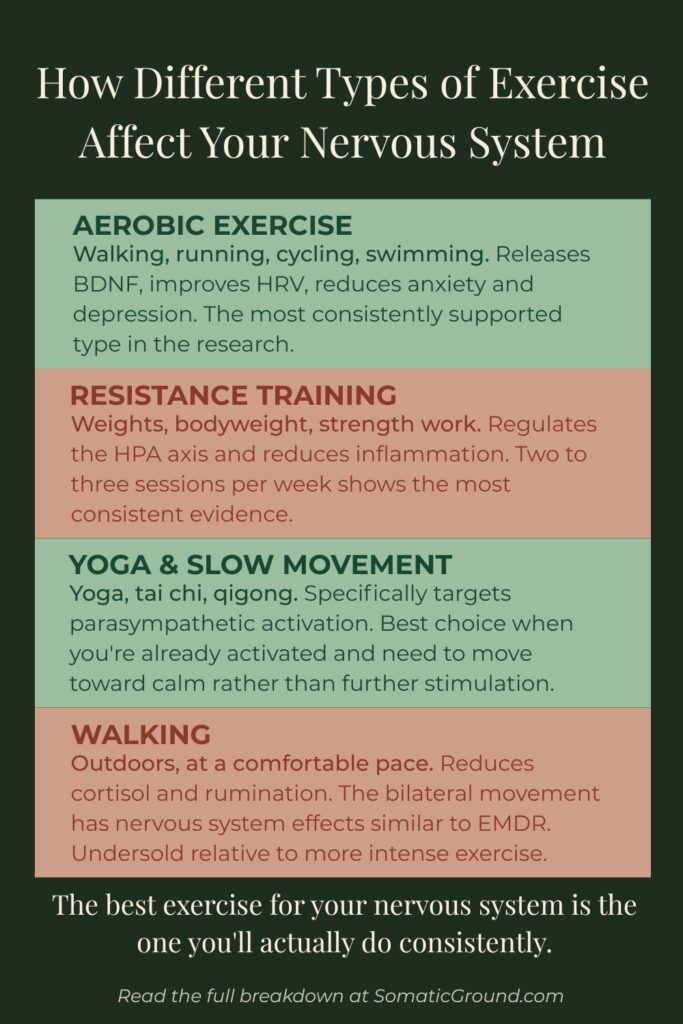
Aerobic exercise has the strongest evidence for nervous system health, anxiety reduction, and depression. Walking, running, cycling, swimming, and similar sustained cardio activities at moderate intensity produce the most consistent BDNF release and HRV improvement in the research. The threshold is lower than most people assume, with 20-30 minutes of moderate intensity activity most days producing significant benefits.
High-intensity exercise produces larger acute stress responses and larger parasympathetic rebounds, which can be beneficial for nervous system training but is also more demanding of recovery resources. For people who are already chronically stressed or depleted, very high-intensity exercise can add to the load rather than helping with it. The HRV drop after intense exercise, which can persist for 24-48 hours, is a useful signal that the body is in recovery rather than ready for more.
Resistance training has growing evidence for anxiety and mood, with mechanisms that partially overlap with aerobic exercise but also include specific effects on the HPA axis and inflammatory pathways. Two to three sessions per week appears to be the range with the most consistent evidence.
Yoga and slow movement practices like tai chi and qigong combine movement with breath and body awareness in ways that specifically target the parasympathetic system. The evidence for these approaches in anxiety, stress, and HRV improvement is solid and they are particularly well-suited for people who are already highly activated and need to move toward regulation rather than further activation.
Walking, specifically, deserves mention because it tends to get undersold relative to more intense exercise. Walking at a comfortable pace outdoors, particularly in natural environments, shows consistent effects on cortisol, mood, and rumination in the research, and the bilateral nature of walking, alternating left-right movement, appears to have additional nervous system effects related to the same mechanism as EMDR’s bilateral stimulation.
Exercise and trauma
For people with trauma histories, the relationship between exercise and nervous system health requires some nuance.
High-intensity exercise that produces strong activation can sometimes trigger rather than regulate a nervous system that is already calibrated toward hypervigilance. The physiological similarities between intense exercise and a threat response are real, and for some people the heart racing and breath shortening of intense exertion activates threat responses rather than the intended training effect.
Slow, rhythmic movement, walking, gentle swimming, yoga, and tai chi tend to be better tolerated and more immediately regulating for this population. Building intensity gradually over time, as the nervous system develops more flexibility, is a more useful approach than starting with high intensity and working backward.
Body-based awareness during movement is also relevant. Exercise that includes attention to the body’s sensations, not just the performance metric, builds interoceptive capacity alongside physical fitness, and interoception is directly relevant to emotional regulation.
The consistency problem
The nervous system benefits of exercise accumulate with consistency and diminish with inconsistency. This is worth being direct about because it’s where most exercise advice falls short.
A single run doesn’t change your HRV, and three intense sessions in a week followed by two weeks of nothing produces minimal lasting nervous system adaptation. The training effect requires repeated exposure over time, with enough recovery between sessions to allow adaptation rather than just accumulated fatigue.
For nervous system health specifically, moderate intensity movement most days is more valuable than occasional intense sessions. Five 30-minute walks per week does more for vagal tone and HRV than one exhausting weekend workout.
Finding movement that is sustainable in your actual life, not the idealised version, is the most important factor. The best exercise for your nervous system is the one you’ll actually do consistently.
Read next
- Heart Rate Variability: What It Is and How to Improve It
- What Is the Window of Tolerance?
- How to Stimulate Your Vagus Nerve at Home: 12 Science-Backed Ways
SomaticGround.com explores the science of the nervous system and its connection to relationships, healing, and the embodied life. All content is for educational purposes and is not a substitute for professional medical or psychological care.