

How to Set Boundaries Without Destroying the Relationship
This post contains affiliate links. If you buy something through one of them, we may earn a small commission — at no extra cost to you. We only recommend things we'd genuinely stand behind.
Boundaries get talked about as though they’re confrontational by nature. They don’t have to be.

Boundaries have become one of those words that carries so much freight it’s almost lost its usefulness. In some corners of wellness culture they’ve become a kind of identity statement, a signal of self-respect, or something you either have or dramatically lack. In others they’re treated as inherently confrontational, a way of pushing people away dressed up in therapeutic language.
Neither framing is particularly helpful, and neither reflects what boundaries actually are or what setting them well actually looks like.
A boundary, at its most basic, is information. It tells another person how you work, what you need, and what you’re not able to do or tolerate. It’s not a punishment or an ultimatum, and it’s not a wall. Set well, it’s one of the more honest things you can offer someone you’re in relationship with.
Why boundaries feel so hard
For most people who struggle to set boundaries, the difficulty isn’t conceptual. They understand the idea. The difficulty is what happens in the nervous system when they try to actually do it.
Setting a limit with someone you care about activates the same threat circuitry as any other relational risk. The attachment system registers the possibility of rejection, conflict, or the other person’s displeasure, and responds accordingly. For someone with anxious attachment, who is already monitoring the relationship’s temperature closely, the anticipation of the other person’s disappointment or anger can feel catastrophic enough to make the boundary feel not worth setting. For someone with avoidant attachment, the whole conversation feels like too much closeness and they’ll find a way to avoid having it entirely.
For people who grew up in environments where expressing needs was dangerous, or where other people’s emotional states were something to be carefully managed, the association between asserting yourself and losing the relationship is old and deep. It doesn’t respond well to being told that healthy people set limits and you should too.
This is where the nervous system framing helps. Setting a limit isn’t primarily a communication skill problem. It’s a nervous system regulation problem. You need enough felt safety, enough window of tolerance, to stay present through the discomfort of saying something the other person might not want to hear, and to wait out their initial response without immediately capitulating or escalating.
What boundaries actually look like
The version of limit-setting that gets modelled in a lot of content is quite formal and often adversarial. “I need you to know that X is not acceptable to me and if it continues I will Y.” This has its place, but it’s not what most relational limits sound like when they’re being set well in ordinary life.
More commonly they sound like:
“I can’t talk about this tonight, I’m too depleted, but I want to come back to it tomorrow.”
“I need some time on my own after work before I’m available for conversation. That’s not about you.”
“That comment hurt, and I’d rather you didn’t say things like that about me.”
“I’m not able to do that favour, but here’s what I can do.”
“I don’t want to keep having this same argument in the same way. Can we try something different?”
These are limits, but they’re offered as information about the person’s experience and needs rather than as demands or ultimatums. They leave room for the other person to respond, and they tend to land differently than the more formal version.
The difference between a boundary and a demand
This distinction matters and often gets missed.
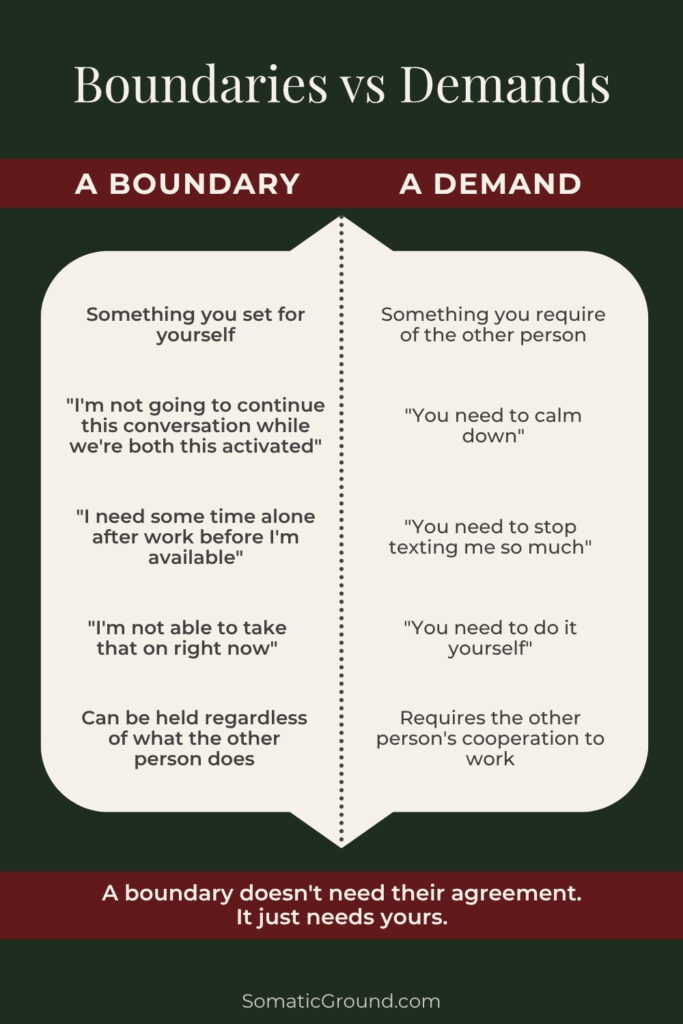
A limit is something you set for yourself. It describes what you will or won’t do, what you need, how you work. “I’m not going to continue this conversation while we’re both this activated” is a limit. It’s about your own behavior and your own capacity.
A demand is something you’re requiring of the other person. “You need to stop doing X” is a demand. It might be entirely reasonable, but it’s structurally different from a limit because it puts the responsibility on someone else to change their behavior rather than you clarifying your own.
Both can be appropriate in different situations, but conflating them creates problems. When people say “I set a limit and they didn’t respect it,” they often mean “I told them what to do and they didn’t do it,” which is a demand that wasn’t met rather than a limit being violated.
A limit can be held regardless of whether the other person changes their behavior. If you’ve said you’re not going to continue a conversation at a certain volume and your partner raises their voice, you can leave the room. You don’t need their cooperation to hold your own limit.
When the other person reacts badly
This is the moment most people are actually afraid of when they think about setting limits, and it’s worth addressing directly.
Some people will react to limits with hurt, anger, or withdrawal, especially if the relationship has operated without them up to now. An initial negative reaction doesn’t mean the limit was wrong or that you’ve damaged the relationship. It means you’ve introduced a change and the other person is responding to it.
Sitting with the discomfort of someone else’s displeasure, without immediately taking the limit back or escalating in response to their reaction, requires the nervous system regulation described above. The window of tolerance needs to be wide enough to hold both your own discomfort and the other person’s response without either collapsing or fighting.
If the other person’s reaction to a reasonable limit is consistently extreme, disproportionate, or punishing, that’s information about the relationship rather than about the limit. A relationship that can only function without any limits at all is one worth examining carefully.
Timing and state
Limits set from a dysregulated state, flooded, shut down, or in the middle of an argument, tend to land badly regardless of how reasonable the content is. The tone carries more information than the words, and a limit delivered in anger reads as an attack, while one delivered from shutdown doesn’t land at all.
The most effective limits tend to be set when both people are relatively regulated, outside of conflict, and when there’s enough relational warmth in the room that the conversation doesn’t immediately feel adversarial. This often means having the conversation earlier than it feels necessary, before the situation has escalated to the point where the dysregulation is unavoidable.
This is also why working on your own nervous system regulation is directly relevant to the relational skill of limit-setting. The more regulated you are, the more access you have to the calm, clear communication that makes limits land as information rather than threat.
Limits with people who consistently don’t respond well
Most of this article assumes a relationship with a basically reasonable person who is capable of hearing a limit and adjusting over time, even if their initial reaction is difficult.
Not everyone is that person, and it’s worth being honest about this.
Some people will consistently treat limits as provocations, will escalate rather than adjust, or will use withdrawal of affection or connection as a response to any assertion of needs. In these cases, the question of limits becomes less about how to set them skillfully and more about what the pattern of responses tells you about the relationship and what you’re willing to accept.
This is harder territory and often benefits from support. Online-Therapy.com has therapists experienced in working with these kinds of relational dynamics if you want help thinking through what you’re navigating. Get 20% off when you use code THERAPY20.
Nedra Tawwab’s Set Boundaries, Find Peace is probably the most practically useful book on this topic available, written clearly and without the more performative framing that a lot of boundary content carries.
Read next
- How to Stop Abandoning Yourself in Relationships
- Secure Attachment: What It Looks Like and How to Build It
- How to Repair Ruptures in Relationships
SomaticGround.com explores the science of the nervous system and its connection to relationships, healing, and the embodied life. All content is for educational purposes and is not a substitute for professional medical or psychological care.