

Avoidant Attachment and the Nervous System: Why Closeness Feels Unsafe
This post contains affiliate links. If you buy something through one of them, we may earn a small commission — at no extra cost to you. We only recommend things we'd genuinely stand behind.
Avoidant attachment isn’t about not needing people. It’s about a nervous system that learned needing people was risky.

Of the insecure attachment styles, avoidant is the one most likely to be mistaken for health.
Avoidantly attached people tend to present as independent, capable, and emotionally stable. They don’t appear to need much from others. They handle stress on their own. They’re often described as low-maintenance partners. From the outside, and frequently from the inside too, this reads as maturity or self-sufficiency.
The nervous system picture underneath is more complicated.
Where avoidant attachment develops
Avoidant attachment develops in response to caregiving that is consistently emotionally unavailable or dismissive of attachment needs. The caregiver may be physically present but emotionally distant, uncomfortable with emotional expression, or consistently unresponsive to distress in a way that communicates: your needs are too much, you’ll manage better alone.
The child’s attachment system, which is biological and not optional, continues to drive them toward the caregiver. But the response to expressing attachment needs is reliably discouraging, and so the nervous system develops a workaround. It learns to suppress the awareness of attachment needs rather than express them. Not to need, or at least to behave as though it doesn’t.
This is an adaptive strategy. It reduces the experience of repeated rejection. It allows the child to maintain proximity to the caregiver without triggering the dismissal that emotional expression produces. In the environment it developed in, it works.
The problem, as with all insecure attachment adaptations, is that it persists long after the environment that shaped it has changed.
The nervous system mechanics
Avoidant attachment is associated with what Porges would describe as dorsal vagal dampening, a downregulation of emotional activation rather than the hyperactivation characteristic of anxious attachment. The system learned to turn the volume down on emotional and attachment-related experience rather than turn it up.
This shows up in the neuroscience research in a specific way. Neuroimaging studies find that avoidantly attached people show reduced activation in attachment-related brain regions during tasks that activate these regions in securely attached people. The attachment system is present and does activate. It appears to be actively suppressed rather than absent.
This matters because the suppression has a physiological cost. Research using concurrent physiological measurement finds that avoidant individuals often show elevated autonomic arousal during emotionally close interactions even when their self-reported emotional experience is minimal. The body is activated. The awareness of the activation has been dampened. The stress is being carried somewhere the person can’t easily access.
What it looks like in relationships
In adult relationships, avoidant attachment tends to produce a particular set of patterns that are consistent with the underlying nervous system strategy.
Closeness feels comfortable up to a point. When a relationship begins to deepen, when a partner starts expecting more emotional availability or expresses attachment needs more directly, the nervous system registers this as a signal that needs suppression. The distancing begins. It often doesn’t feel like a choice. It feels like a preference for space, or a loss of attraction, or a sense that the relationship has become too intense.
Conflict typically produces withdrawal rather than escalation. The avoidant person goes quiet, becomes less available, or disengages from the conversation. As discussed in the nervous system shutdown article, this isn’t indifference. It’s a shutdown response from a system that learned emotional activation in close relationships is something to manage away from rather than into.
The avoidant person is also frequently unaware of their own emotional state in relational contexts. The suppression that began as a strategy for managing attachment needs has become a general dampening of emotional awareness. Feelings that would be accessible to a securely attached person, sadness, longing, fear of loss, are often genuinely not accessible until significant time and distance have passed.
The avoidant-anxious dynamic
Avoidant attachment pairs with anxious attachment with notable frequency, and the dynamic between them has a physiological logic.
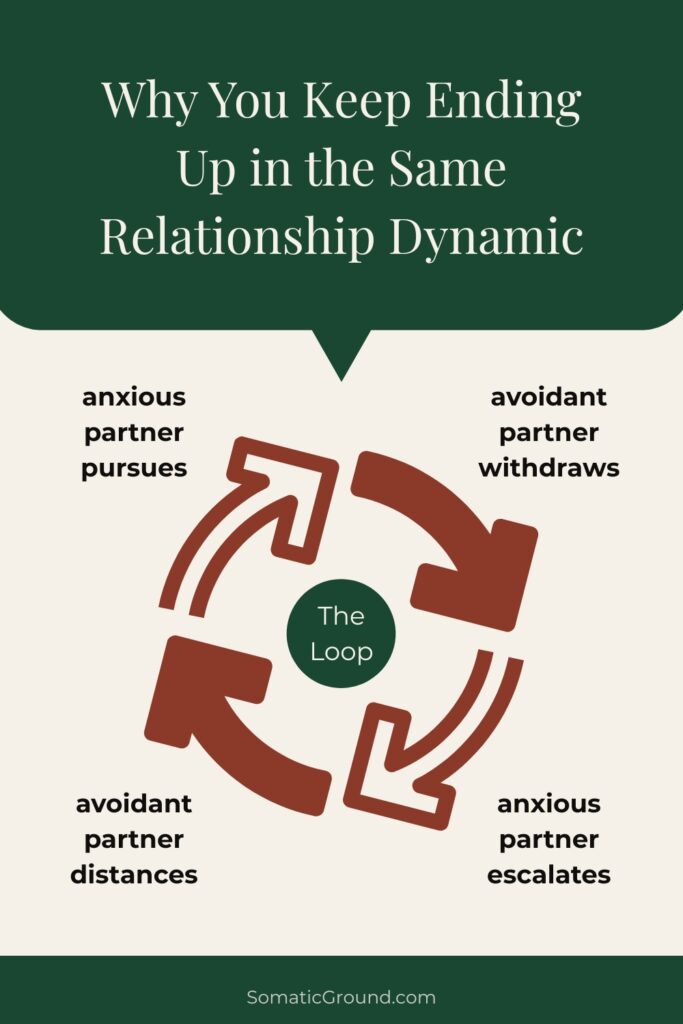
The anxious partner’s activation, their pursuit of closeness and reassurance, triggers the avoidant partner’s suppression response. The more the anxious partner pursues, the more the avoidant partner distances. The distancing confirms the anxious partner’s fear and increases their activation. The increased activation increases the distancing.
Neither person is doing this deliberately. Both are nervous systems running the strategies they developed. The avoidant partner isn’t being cruel. The anxious partner isn’t being irrational. They’re both stuck in a loop that the strategies themselves are maintaining.
Understanding this at a physiological level, rather than as a character problem on either side, is usually the precondition for anything to shift.
What helps
Avoidant attachment patterns are slower to shift than anxious ones in therapy, partly because the suppression strategy is effective enough that the distress driving it is less accessible. You can’t easily work with something you can’t feel.
Body-based approaches tend to be more effective than purely cognitive ones for this reason. Somatic therapy, EMDR, and approaches that work with physiological activation rather than narrative can help the avoidant person make contact with the emotional experience that the suppression has been keeping out of awareness. This tends to be a gradual process. Online-Therapy.com has practitioners trained in somatic and attachment-focused approaches if you want to explore that. Use code THERAPY20 for 20% off.
Relationships that offer consistent, low-pressure safety over time do provide new data to the nervous system. A partner who doesn’t escalate in response to distancing, who can tolerate some degree of withdrawal without it becoming a crisis, and who is still reliably present when the avoidant person does return, gives the nervous system the repeated experience that closeness doesn’t have to end the way early closeness did.
This requires a particular kind of patience that isn’t easy to sustain without understanding the underlying dynamic. Stan Tatkin’s Wired for Love is probably the most practically useful book for couples navigating this, written for both people in the relationship rather than just the one in therapy.
Building general nervous system flexibility through body-based regulation practice matters too. A wider window of tolerance means more capacity to stay present when closeness activates the old suppression response rather than immediately defaulting to distance.
A note on self-recognition
Avoidant attachment is sometimes difficult to recognise in yourself precisely because the suppression strategy that characterises it also suppresses the distress that would otherwise make the pattern more obvious. People with anxious attachment usually know something is wrong. People with avoidant attachment often feel fine right up until a relationship ends or a partner finally gives up, at which point the feelings that were suppressed become briefly and sometimes overwhelmingly available.
If you recognise the patterns described here, that recognition is itself significant. The suppression strategy is most effective when it’s completely outside awareness. Bringing it into awareness, even partially, is where the possibility of working with it begins.
Read next
- How Your Attachment Style Affects Your Nervous System
- Anxious Attachment and the Nervous System: What’s Actually Happening
- Why Your Nervous System Shuts Down in Arguments
SomaticGround.com explores the science of the nervous system and its connection to relationships, healing, and the embodied life. All content is for educational purposes and is not a substitute for professional medical or psychological care.