

What Is the Window of Tolerance?
This post contains affiliate links. If you buy something through one of them, we may earn a small commission — at no extra cost to you. We only recommend things we'd genuinely stand behind.
The concept that explains why some days you can handle anything and others you can’t handle anything at all.

Some days you can handle a difficult conversation, a packed schedule, and unexpected bad news without falling apart. Other days, a single annoying email tips you into overwhelm. The difference isn’t your personality or your character. It’s your nervous system’s current capacity, what trauma therapist Dan Siegel called the window of tolerance.
It’s one of the more practically useful concepts in the nervous system literature, and understanding it tends to change how people relate to their own reactions.
What it means
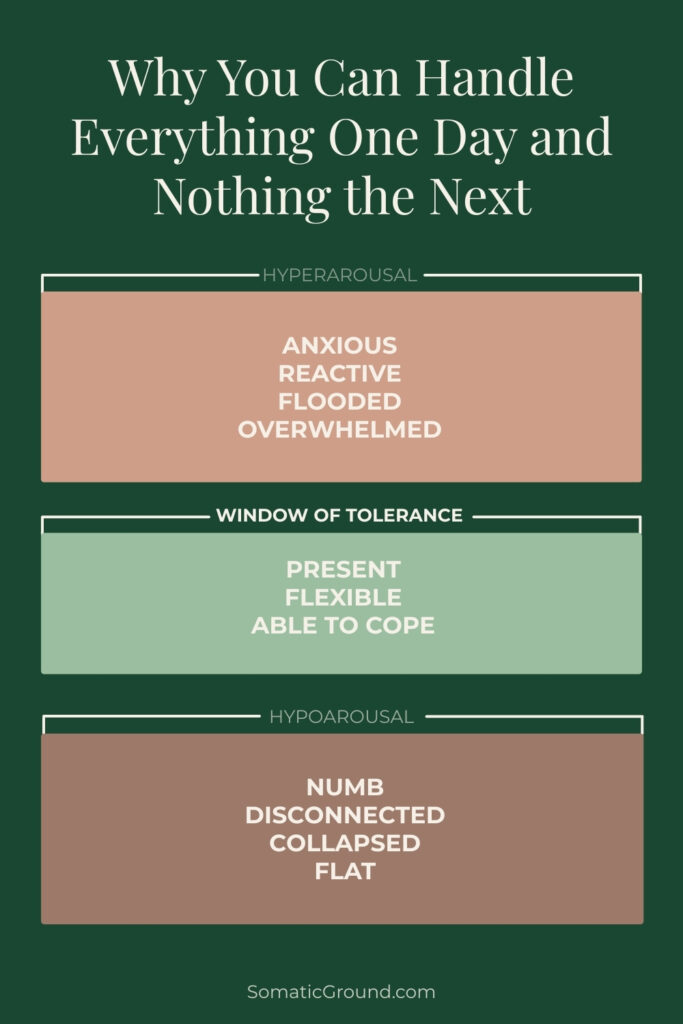
The window of tolerance describes the zone in which your nervous system can function effectively. Inside it, you can think clearly, feel your feelings without being overwhelmed by them, stay present in your body, and engage with other people. You can handle stress, sit with discomfort, and process difficult things.
Outside of it, you can’t. At least not well.
The window has two edges. Go above the upper edge and you’re in hyperarousal: flooded, reactive, anxious, and overwhelmed. Go below the lower edge and you’re in hypoarousal: shutdown, numb, disconnected, and flat. Both states compromise your capacity to function, relate, and process what’s happening.
Everyone has a window of tolerance. The size varies enormously from person to person, and it varies within the same person depending on the day, the context, how much sleep you’ve had, and what else you’re carrying.
What hyperarousal looks like
Above the window, the sympathetic nervous system is running the show.
You may have racing thoughts, difficulty concentrating, a mind that won’t settle anywhere, physical agitation, an inability to sit still, or feel restless and tense. It can also come with feelings that arrive fast and big and are hard to stay with, disproportionate reactions to small things, panic, rage, or intense anxiety. Along with a sense that everything is urgent and nothing can wait.
At moderate levels this might just feel like stress. At higher levels it can feel like losing control entirely.
What hypoarousal looks like
Below the window, the dorsal vagal system has taken over, and it looks quite different.
You may experience numbness, flatness, a general absence of feeling, exhaustion that doesn’t respond to rest, a foggy, slow mind, or disconnection from the body. It can feel like you’re going through the motions without being fully present, and there’s a heaviness present that makes even small tasks feel like more than you have.
This state often gets misread as laziness, depression, or not caring. It’s usually a nervous system that hit its limit and dropped below the floor.
What narrows the window
The window of tolerance isn’t fixed. It narrows under certain conditions and can widen with the right support and practice.
Chronic stress, poor sleep, inadequate nutrition, illness, and isolation all narrow it. Unprocessed trauma is a significant factor as well. Traumatic experiences that haven’t been metabolised tend to leave the nervous system in a state of partial activation, which means less available capacity before you hit the edges. Relational stress is particularly narrowing because the nervous system is a social organ and conflict or disconnection with people we’re close to is among the most activating experiences there is.
Early experiences matter too. People who grew up in environments that were unpredictable, unsafe, or chronically stressful often have a narrower window as a baseline. The nervous system calibrated itself to a smaller range of tolerable experience because that was what the environment required.
What widens it
The window can be expanded. Not quickly, and not through willpower, but through consistent experience of moving toward the edges and coming back, through practices that build the nervous system’s flexibility over time.
Body-based regulation practices do this. Breathwork, movement, cold exposure, time in nature, anything that gently activates the system and then allows it to return to baseline is giving the nervous system practice at recovery. Over time recovery becomes faster and the edges of the window move outward.
For people whose window has been significantly narrowed by trauma, somatic therapy tends to be the most direct route. The therapeutic relationship itself is regulating, a consistent, safe, attuned presence that the nervous system can orient to. Somatic Experiencing, EMDR, and similar approaches work directly with the edges of the window, helping the system process what’s been stuck and gradually expand its capacity. Online-Therapy.com has therapists trained in these approaches. Get 20% off with code THERAPY20.
Sleep, nutrition, and reducing ongoing stressors matter more than they’re usually given credit for. The window narrows when the body is depleted. Basic physiological maintenance isn’t glamorous but it does a lot of the work.
Co-regulation helps too. Being in the presence of someone whose nervous system is regulated, a calm partner, a good friend, a therapist, is one of the fastest ways to return to the window when you’ve gone outside it. More on that in the next article.
For reading, Peter Levine’s Waking the Tiger is the foundational text on trauma and the nervous system and covers the window of tolerance in accessible detail.
Why it matters for relationships
Two people in a relationship are two windows of tolerance in constant interaction.
When both people are inside their windows, difficult conversations, repair, and genuine connection are all possible. When one or both people are outside their window, flooded or shut down, the conversation that’s happening isn’t really the one you need to have. Both people are in survival mode, doing the best they can with compromised capacity.
This is why timing matters so much in relationships, not just emotionally but physiologically. A conversation that derails at 11pm after a hard week might go completely differently on a Saturday morning when both nervous systems are rested.
Understanding your own window, where it sits, what narrows it, and what returns you to it, is some of the most practical self-knowledge available. Understanding your partner’s window is some of the most useful relational knowledge there is.

Read next
- Co-Regulation: Why You Need a Calm Partner to Feel Safe
- Signs Your Nervous System Is Dysregulated
- How to Stimulate Your Vagus Nerve at Home: 12 Science-Backed Ways
SomaticGround.com explores the science of the nervous system and its connection to relationships, healing, and the embodied life. All content is for educational purposes and is not a substitute for professional medical or psychological care.