

Signs Your Nervous System Is Dysregulated
This post contains affiliate links. If you buy something through one of them, we may earn a small commission — at no extra cost to you. We only recommend things we'd genuinely stand behind.
You’re not overreacting. Your nervous system is just stuck in a pattern it learned a long time ago.

“Dysregulated” gets used a lot in wellness spaces without much explanation. Your therapist might have used it about you. You might have come across it in something you were reading and wondered whether it applies.
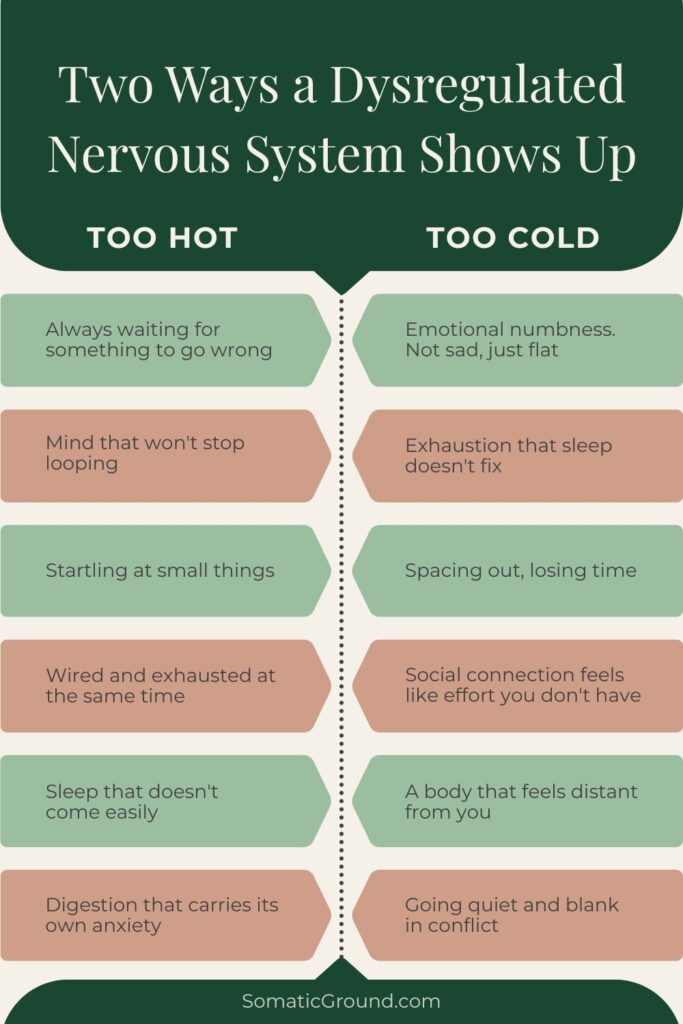
The nervous system is dysregulated when it’s stuck. Either running too hot, locked in a state of activation that won’t switch off, or running too cold, shutdown and flat in a way that makes it hard to feel much of anything. In both cases the system has lost its flexibility. It’s responding to an old map rather than what’s actually in front of it.
Here’s what that tends to look like.
Running too hot
This is the more recognisable version. The one that overlaps with anxiety, hypervigilance, and an inability to switch off.
You startle easily. Loud noises, sudden movements, an unexpected message. Your body responds with a jolt that feels out of proportion. The threat-detection system is calibrated too sensitively, firing at things that don’t warrant it.
There’s a background sense that something is about to go wrong. Not necessarily a conscious thought, more like a low hum of dread that persists even when you can see that things are fine.
Small things set you off. A tone of voice, a slight change in someone’s behaviour, a minor inconvenience. The reaction is bigger than the situation, and often you know that in the moment, which adds frustration on top of whatever you were already feeling.
Your mind won’t stop. Replaying conversations, rehearsing future ones, running worst-case scenarios. This isn’t a thinking problem, it’s a nervous system problem. The body is in a mobilised state and the mind is searching for the threat that justifies it.
Sleep is difficult. Falling asleep, staying asleep, or waking at 3am with a mind that’s already running. A sympathetically dominant system doesn’t know how to hand over to rest.
Your digestion is off. Bloating, nausea, IBS-type symptoms, a stomach that seems to carry its own separate anxiety. The vagus nerve runs directly through the digestive system and dysregulation tends to show up there early.
Wired and exhausted at the same time. Too tired to function, too activated to rest. The accelerator and the brake both partially on.
Running too cold
Less talked about, but just as significant. This doesn’t look like anxiety. It tends to look like depression, disconnection, or a kind of persistent flatness.
Emotional numbness. Not sad exactly, not anxious, just not much of anything. Feelings that should be present aren’t, or they’re muffled, like watching your own life through glass.
Exhaustion that sleep doesn’t fix. Different from the wired exhaustion above. Heavier, more collapsed. Ordinary tasks feel like they require more than you have.
Dissociation. Spacing out, losing chunks of time, finding yourself mid-conversation with no idea what was just said. Mild dissociation isn’t always dramatic. It can just look like being checked out – a lot.
Social connection feels like effort you don’t have. Not introversion, but a specific flatness around engaging with people, even ones you care about.
Your body feels distant. Difficulty sensing hunger, temperature, or physical discomfort. A general disconnection from what’s happening inside you.
You go flat in conflict. Where someone else might get heated, you just go quiet. The words stop coming and you’re not sure what you feel. This often reads as not caring, but it’s usually the system getting overwhelmed and taking the only exit it could find.
The mixed state
A lot of people cycle between both, activated and anxious in some situations, but shut down and flat in others, or oscillating through both within the same day. It’s not unusual. It usually means a nervous system that’s been under pressure long enough that it’s lost the flexibility to find a stable middle ground.
How it develops
Dysregulation rarely appears out of nowhere. It tends to develop in response to sustained stress, trauma, or an early environment where the nervous system never had consistent experience of safety and recovery.
When the system gets activated repeatedly without adequate recovery, through chronic stress, difficult relationships, ongoing uncertainty, childhood adversity, or a single overwhelming event, it adapts. It recalibrates its baseline toward vigilance. Activation becomes normal. Rest starts to feel unsafe.
This isn’t pathology. It’s the nervous system doing exactly what it evolved to do: adapt to the environment it’s in. The problem is that the adaptation persists long after the environment has changed.
What helps
Consistent body-based practice matters more than any single technique. Breathwork, gentle movement, time in nature, cold exposure, and/or humming. The practices covered in our vagus nerve article all apply. The key word is consistency. The nervous system updates through repetition, not through one good session.
Reducing ongoing load helps too. Dysregulation is often maintained by stressors that are still active: an unsustainable schedule, a difficult relationship, chronic sleep deprivation. Working with the body is harder when it’s being continuously overloaded.
For people whose dysregulation runs deep, somatic therapy tends to be more effective than talk therapy alone, because the patterns live in the body and need body-based intervention to shift. Somatic Experiencing, EMDR, and sensorimotor approaches work directly with the physiology rather than just the narrative. Online-Therapy.com (20% off with code THERAPY20) has practitioners trained in these approaches.
For periods when the usual practices aren’t cutting through, devices like Sensate offer a more direct vagal stimulation route. It’s become fairly popular among somatic therapists working with people who find breath-based regulation hard to access.

One thing worth saying
Recognising dysregulation in yourself is a useful starting point. But identifying the pattern is different from understanding what’s driving it. If several of the above feel persistently true, working with someone who understands the nervous system tends to go further than working on it alone — not because something is wrong with you, but because this kind of work has more traction with support.
Read next
- Why Your Nervous System Shuts Down in Arguments
- What Is the Window of Tolerance?
- How to Stimulate Your Vagus Nerve at Home: 12 Science-Backed Ways
SomaticGround.com explores the science of the nervous system and its connection to relationships, healing, and the embodied life. All content is for educational purposes and is not a substitute for professional medical or psychological care.