

Co-Regulation: Why You Need a Calm Partner to Feel Safe
This post contains affiliate links. If you buy something through one of them, we may earn a small commission — at no extra cost to you. We only recommend things we'd genuinely stand behind.
Self-regulation gets a lot of attention, but the nervous system didn’t evolve to do this alone.

There’s a version of wellness culture that treats nervous system regulation as a solo project. Breathwork you do alone, meditation apps in your earbuds, cold plunges, journaling – all of these things have value. However, the framing misses something fundamental about how the nervous system actually works.
The nervous system is a social organ. It didn’t evolve in isolation, it evolved in relationship, calibrated from the very beginning by contact with other nervous systems. Self-regulation is a skill worth building, but it’s a downstream capacity that develops through co-regulation first.
What co-regulation is
Co-regulation is the process by which one person’s regulated nervous system helps stabilise another’s. This is a physiological process, documented in the research, that happens through proximity, voice, facial expression, touch, and breath.
Polyvagal Theory explains the mechanism. The ventral vagal system, the branch of the autonomic nervous system responsible for the safe-and-social state, is specifically tuned to pick up cues of safety from other people. The prosody of a calm voice, the openness of a relaxed face, and the steadiness of a body at ease. These signals are processed faster than conscious thought and communicate, at a physiological level, that it’s safe to settle.
This is not something you decide to do. It happens automatically, which is why being around a genuinely calm person feels different in your body and not just in your mind.
Where it starts
Co-regulation doesn’t begin in adult relationships. It begins in infancy.
A baby’s nervous system is not yet capable of self-regulation. It depends entirely on the caregiver to provide regulation from the outside, through holding, rocking, voice, warmth, eye contact, and responsive attunement to distress. When a baby cries and is consistently picked up, soothed, and settled, it isn’t just being comforted. Its nervous system is being regulated by another nervous system. Through thousands of these interactions, the baby begins to internalise the capacity for self-regulation. It learns, through repeated co-regulation, how to eventually do some of this on its own.
This is why the quality of early caregiving has such a lasting effect on nervous system function. It’s not only about attachment, though it is related. It’s about whether the developing nervous system had consistent access to an external regulator during the period when it was learning what regulation even feels like.
People who didn’t have reliable co-regulation early on often find self-regulation harder as adults, not because of a character flaw, but because the scaffolding wasn’t there during the developmental window when it would have been built.
How it works in adult relationships
Throughout our lives we’re affected by the nervous system states of the people around us. This is more pronounced in close relationships where the nervous system has established a sense of safety and familiarity.
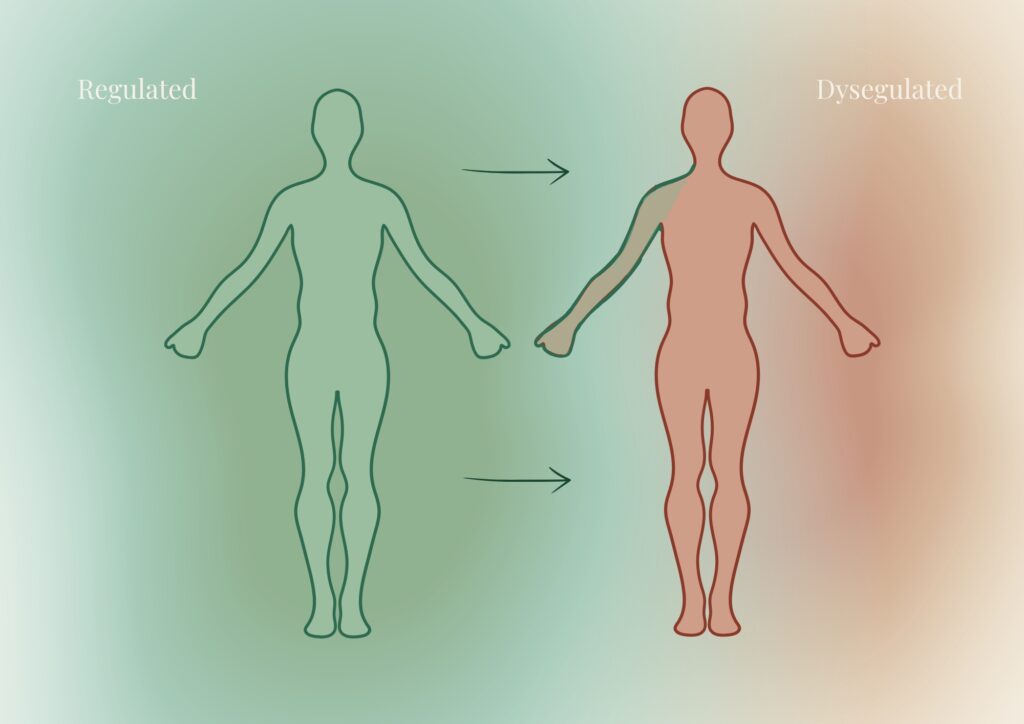
A partner who comes home activated and dysregulated will often pull the other partner’s nervous system upward with them. The reverse is also true – a partner who is genuinely calm and grounded can bring a dysregulated system down without doing anything overtly therapeutic. Just being present, unhurried, and regulated is doing something beneficial.
The quality of the nervous system states you spend time around matters as a physiological reality, not just an emotional preference. Chronically dysregulated relationships with high conflict that are unpredictable and emotionally volatile actively maintain dysregulation by depriving both people of the co-regulatory resource they need to settle.
One person’s nervous system work has a direct effect on the other. When you do the work to widen your window of tolerance and show up calmer in conflict, you’re not just changing yourself. You’re changing the co-regulatory environment your partner lives in.
When co-regulation isn’t available
For people who grew up without reliable co-regulation, or who are in relationships that are themselves dysregulating, the absence of this resource is significant.
This is part of why isolation is so damaging to mental health, and part of why the therapeutic relationship is genuinely healing rather than just informative. A therapist who is consistently regulated, attuned, and safe is providing something real at a nervous system level, not just a cognitive one.
It’s also part of why anxious attachment is so hard to self-regulate out of. The nervous system learned early that its primary co-regulatory resource was unreliable. The hypervigilance that follows isn’t irrational, it’s a reasonable adaptation to an environment where the external regulator couldn’t be counted on. Telling someone in that pattern to just self-regulate is a bit like telling someone to pull themselves up by bootstraps they were never given.
What this means practically
Building co-regulatory relationships is legitimate nervous system work, not just a nice thing to have.
Therapy is one route in. The consistent attunement of the therapeutic relationship provides co-regulation over time, and for many people it’s the first experience of a reliably regulated other. Online-Therapy.com is a practical option for accessing that kind of support without the barrier of finding someone local. Use code THERAPY20 for 20% off.
The quality of your friendships and communities matters too. The nervous system is affected by group regulation, which is part of why certain environments feel nourishing and others feel draining even when nothing overtly stressful has happened.
And understanding your partner as a co-regulatory resource changes how you think about the relationship itself. Not in a transactional way, but with the recognition that how regulated or dysregulated each of you is has a direct effect on the other. Investing in the health of the relationship, repairing ruptures, building genuine safety between you, is investing in both your nervous systems.
Self-regulation matters and is worth developing. But it exists on a foundation of co-regulation, and for most people that foundation is where the real work is.
Read next
- What Is the Window of Tolerance?
- Anxious Attachment and the Nervous System: What’s Actually Happening
- Why Your Nervous System Shuts Down in Arguments
SomaticGround.com explores the science of the nervous system and its connection to relationships, healing, and the embodied life. All content is for educational purposes and is not a substitute for professional medical or psychological care.