

How to Repair Ruptures in Relationships: A Nervous System Approach
This post contains affiliate links. If you buy something through one of them, we may earn a small commission — at no extra cost to you. We only recommend things we'd genuinely stand behind.
Every close relationship has ruptures. What separates secure relationships from struggling ones isn’t the absence of rupture, it’s the presence of repair.

Rupture is not a sign that something has gone wrong with a relationship, it’s a sign that two people with two nervous systems, two histories, and two sets of needs are in regular close contact. Disconnection, misattunement, conflict, hurt feelings, and moments of not being seen or responded to, are not exceptions in close relationships, they’re the texture of them.
What varies between relationships isn’t whether ruptures happen, it’s whether repair follows.
John Gottman’s research found that even the most stable, happy long-term couples have conflict and disconnection regularly. What distinguished them from couples who struggled wasn’t a lower frequency of rupture, it was a higher frequency of repair. The relationship had developed a culture of coming back to each other, and that culture, built from repeated small acts of repair, was the actual foundation of felt security between the partners.
Understanding repair through a nervous system lens changes how you approach it, and often makes it more accessible.
What a rupture actually is
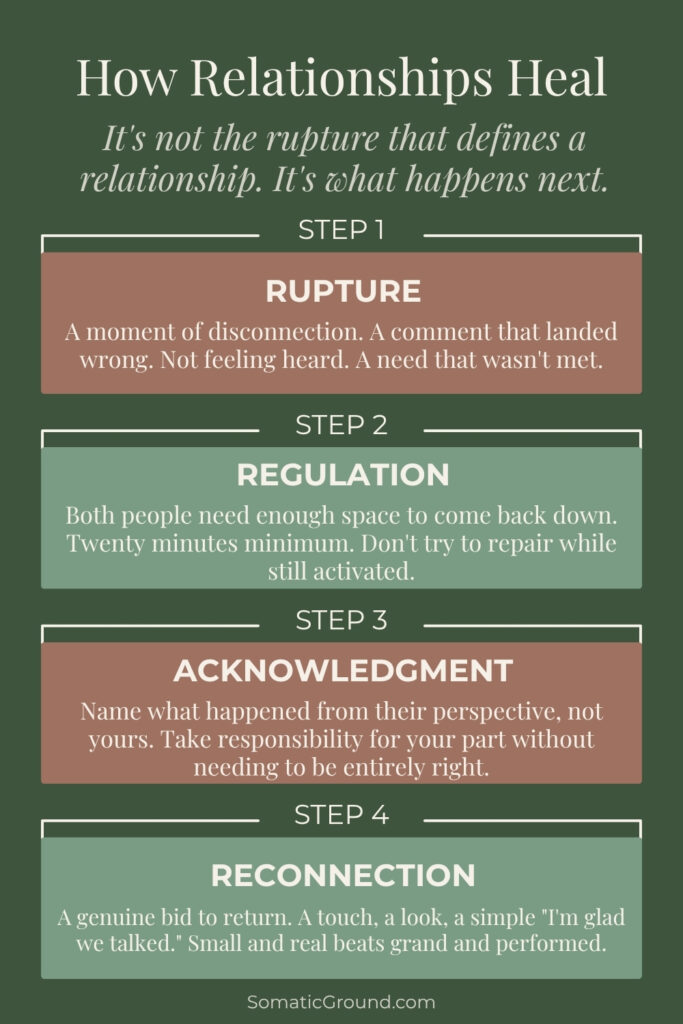
A rupture is any moment of disconnection or misattunement between two people that produces a shift in the felt sense of safety in the relationship. It doesn’t have to be a fight. It can be:
A comment that landed badly.
A moment of not being listened to.
A cancelled plan without enough acknowledgment.
A partner who was distracted during an important conversation.
A tone of voice that carried more edge than was intended.
A need that was expressed and wasn’t responded to.
A moment where one person felt invisible, dismissed, or alone in the relationship.
Small ruptures accumulate if they’re not repaired. The nervous system keeps a running account, not consciously and not precisely, but the felt sense of safety in a relationship is significantly shaped by how often disconnection is followed by reconnection. A relationship where small ruptures regularly go unacknowledged can feel chronically slightly unsafe even in the absence of any major conflict.
Why repair is physiologically difficult
Repair requires vulnerability. It requires one or both people to move toward the other at a moment when the nervous system has just been activated by the rupture and is oriented toward protection rather than connection.
For someone with anxious attachment, the pull toward repair is strong but the fear of rejection in the attempt can be equally strong. Reaching out and not being met feels like confirmation of the worst fear.
For someone with avoidant attachment, the shutdown that often follows rupture makes accessing the warmth and openness that repair requires genuinely difficult. The system has learned to manage relational activation by distancing, and repair requires moving in the opposite direction.
For someone with disorganized attachment, both of the above can be true simultaneously, the pull toward repair and the fear of it cycling rapidly without resolution.
This is why timing matters so much. Attempting repair while both people are still significantly activated tends to produce more rupture rather than resolution. The nervous system needs enough recovery first to have access to the ventral vagal state where genuine connection and communication are possible. As covered in our article on calming after a fight, twenty minutes is a minimum for stress hormones to clear, and longer is often better.
What genuine repair involves
Repair is not the same as resolution. Resolution means the underlying disagreement or issue has been sorted out. Repair means the connection between two people has been restored. These are different things and repair often needs to come before resolution is possible.
Genuine repair involves some combination of:
Acknowledgment. Naming what happened from the other person’s perspective rather than immediately defending your own. “I can see that what I said landed as dismissive, even if that wasn’t my intention” is repair. “I wasn’t being dismissive, you’re too sensitive” is not.
Taking responsibility for your part. Not necessarily for the whole conflict, but for whatever your contribution to the rupture was. This requires enough nervous system regulation to hold your own perspective and the other person’s simultaneously, which is a prefrontal cortex function that’s less available when the system is activated.
Expressed care for the other person’s experience. Not performed care, but genuine interest in how the other person experienced what happened. The difference is detectable. The nervous system is very good at reading authenticity in voice, face, and body, and performed care often deepens the rupture rather than repairing it.
A bid for reconnection. Some gesture, verbal or physical, that communicates a desire to return to closeness. This can be small, such as a touch on the arm, a genuine smile, “I’m glad we talked about this”, but it needs to be real.
What repair doesn’t require is complete agreement, a definitive account of who was right, or the resolution of the underlying issue. Two people can repair the connection and still disagree about the thing that caused the rupture. The repair restores the safe base from which the harder conversation can then happen.
Building a repair culture
Individual acts of repair matter. What matters more, over the long term, is whether a relationship develops a culture of repair, a shared expectation and practice of coming back to each other after disconnection.
This culture is built incrementally, through small repairs more than large ones. Coming back after a tense exchange and saying “I don’t think that went well, can we try again” is repair. Reaching out after a day of distance and making a small bid for connection is repair. Noticing that something you said landed badly and acknowledging it without being asked is repair.
Each of these small acts adds to the nervous system’s running account of the relationship. Over time, a relationship with a consistent repair culture feels different at a physiological level. The threat-detection system relaxes slightly because the evidence suggests that ruptures are followed by reconnection, that the relationship is safe enough to survive imperfection.
This is also how earned secure attachment develops in relationships. Not through conflict-free connection, but through repeated rupture and repair, through the nervous system learning, again and again, that this relationship is one it can return to.
When repair is harder
Some ruptures are larger and require more than a small bid for reconnection. Significant betrayals, extended periods of disconnection, or patterns of repeated rupture without repair accumulate a charge in the relationship that a single repair attempt can’t discharge.
In these cases, repair often needs support. A therapist working with both people provides a regulated third presence that helps both nervous systems stay within a workable range during conversations that would otherwise produce too much activation to navigate. Emotionally Focused Therapy is specifically designed to work with rupture and repair in couples and has strong research support. Online-Therapy.com has EFT-trained therapists available. Use code THERAPY20 for 20% off.
For relationships where repair has been consistently absent for an extended period, rebuilding the capacity for it takes time and is often slower than the original rupture was fast. Sue Johnson’s Hold Me Tight is the most accessible guide to understanding and rebuilding repair capacity in a relationship, grounded in the EFT research.
A note on repair with yourself
Everything described here applies to the relationship with yourself as much as to relationships with others. The internal ruptures, like moments of harsh self-criticism, self-abandonment, or acting against your own values and then piling on shame, also require repair.
Self-compassion is self-repair. Acknowledging that you did something you regret, taking responsibility without adding unnecessary shame, and offering yourself the same return to warmth you’d want from someone else. This is the internal version of the same process, and the nervous system responds to it in similar ways.
Read next
- Why Your Nervous System Shuts Down in Arguments
- How to Calm Your Nervous System After a Fight
- Secure Attachment: What It Looks Like and How to Build It .
SomaticGround.com explores the science of the nervous system and its connection to relationships, healing, and the embodied life. All content is for educational purposes and is not a substitute for professional medical or psychological care.