

Fearful Avoidant Attachment and the Nervous System
This post contains affiliate links. If you buy something through one of them, we may earn a small commission — at no extra cost to you. We only recommend things we'd genuinely stand behind.
Wanting closeness and being terrified of it at the same time isn’t a contradiction. It’s a nervous system pattern.

Of the four attachment styles, fearful avoidant is the hardest to live in and often the hardest to understand, including from the inside.
Anxious attachment at least has a clear internal logic: connection feels necessary, so you pursue it. Avoidant attachment also has a clear logic: connection feels dangerous, so you maintain distance. Fearful avoidant sits in both positions at once. You want closeness and you’re frightened of it. You pursue connection and then panic when you find it. You leave relationships to protect yourself and grieve them the moment you do.
From the outside this can look inconsistent, unpredictable, even manipulative. From the inside it feels like being at war with yourself. Understanding the nervous system mechanics underneath it doesn’t resolve it, but it does make it make sense.
Where it comes from
Fearful avoidant attachment, also called disorganized attachment in the research, typically develops when the primary caregiver is also a source of fear. This can happen through abuse or significant neglect, but it can also develop through subtler dynamics: a caregiver with unresolved trauma whose fear responses bleed into the relationship, a parent who is sometimes warm and sometimes frightening without apparent pattern, an environment where the person who should be the safe haven is also unpredictable enough to constitute a threat.
The developing child faces an impossible bind. The attachment system, which is biological and not optional, drives them toward the caregiver for safety. But the threat-detection system, equally biological and equally non-optional, registers that same caregiver as dangerous. There is no coherent strategy available. You can’t move toward the source of safety because it’s also the source of threat. You can’t move away because the attachment drive won’t allow it.
The nervous system has no clean resolution to this. What it develops instead is a fragmented pattern, oscillating between approach and withdrawal, activation and shutdown, longing and fear.
The nervous system mechanics
Fearful avoidant attachment is the only style that doesn’t have a stable nervous system strategy underneath it. Anxious attachment runs hot, sympathetically dominant, always monitoring. Avoidant attachment runs cooler, dorsally dampened, needs suppressed. Fearful avoidant oscillates between both, sometimes rapidly.
In practice this means the person can move between sympathetic flooding and dorsal shutdown within a single interaction. Something in the relationship feels threatening (which in a nervous system calibrated to early danger can be as small as a partner seeming distracted), the threat-detection system activates, and depending on the context and the specific trigger, the response might be pursuit and escalation or it might be collapse and withdrawal. The unpredictability isn’t performance. It’s the nervous system running two competing programs with no override.
This also means that the ventral vagal state, the safe-and-social state from which genuine connection and intimacy are possible, is the hardest to access and the hardest to sustain. Getting there requires enough felt safety to allow the system to settle, and for someone with fearful avoidant attachment, felt safety in close relationships is the thing their nervous system learned was unavailable.
What it looks like in relationships
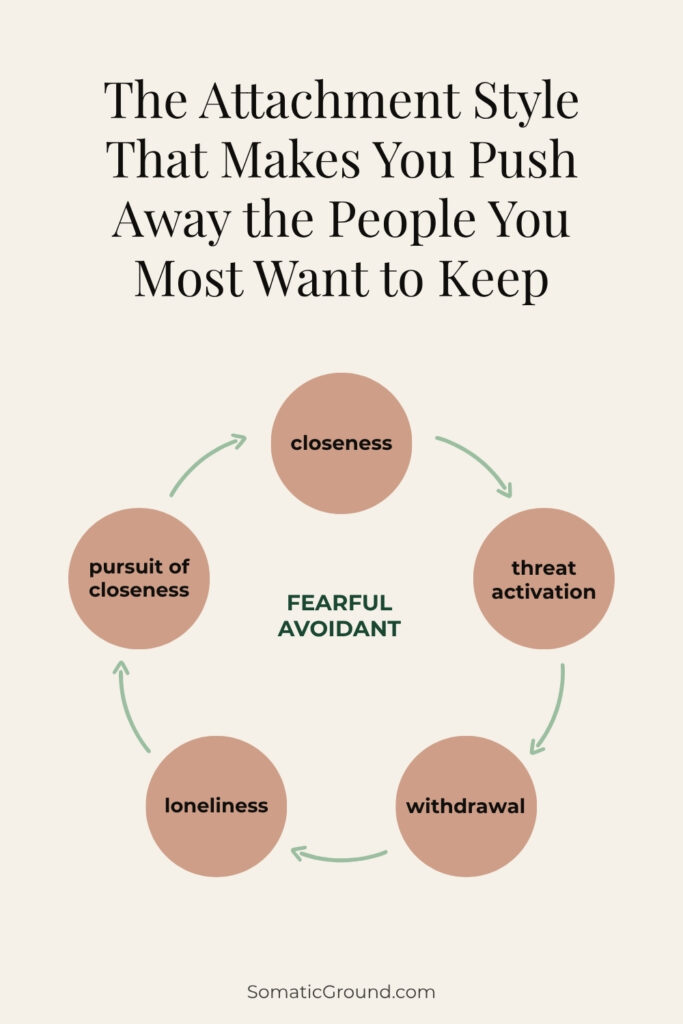
The push-pull pattern that characterises fearful avoidant attachment in relationships has a physiological logic once you understand the underlying states.
In early relationship stages, when things feel novel and not yet threatening, the nervous system can often maintain enough regulation to access warmth, curiosity, and connection. This is sometimes described as fearful avoidants being intensely present and engaged at the start. Then, as the relationship deepens and the stakes rise, the old threat-detection patterns activate. Closeness starts to feel dangerous. The withdrawal begins.
The person on the other side of this, particularly someone with an anxious attachment pattern, often experiences the shift as bewildering. The person who seemed so present and engaged has disappeared. The pursuit that follows activates the fearful avoidant’s threat response further, which deepens the withdrawal, which increases the pursuit. The anxious-avoidant cycle with a fearful avoidant partner tends to be particularly destabilising because the responses are less predictable and the oscillation can be rapid.
What makes this especially hard is that fearful avoidant individuals often genuinely want the relationship. The withdrawal isn’t indifference. It’s a nervous system that has associated closeness with danger and is doing the only thing it knows how to do.
What helps
Fearful avoidant attachment is widely considered the most complex of the four styles to work with, both in therapy and in relationships. That’s not a reason to be pessimistic. It is a reason to be realistic about what’s required.
Therapy that works with the body as well as the narrative tends to be most effective. The fragmented nervous system pattern at the core of disorganized attachment doesn’t resolve through insight alone. Somatic approaches, EMDR in particular, work directly with the stored threat responses and can help the system develop more coherent regulation strategies over time. Attachment-focused therapy provides the corrective relational experience that the nervous system needs: a consistently safe, regulated, attuned other who doesn’t become a source of threat. Online-Therapy.com has therapists trained in both EMDR and attachment-focused approaches. Use code THERAPY20 for 20% off.
Relationships that are consistent, low-conflict, and genuinely safe over time do provide new data to the nervous system. This is slow and requires a partner who understands the dynamic well enough not to take the withdrawal personally or escalate in response to it. Stan Tatkin’s Wired for Love covers the neuroscience of attachment styles in relationships in accessible detail and is worth reading for both people in the relationship.
Building personal regulation capacity outside of relationships also matters. The more flexible the nervous system becomes through consistent body-based practice, the wider the window of tolerance and the more access there is to the ventral vagal state where connection feels possible rather than threatening.
A note on self-recognition
Fearful avoidant attachment is sometimes over-identified with. Not everyone who has complicated feelings about intimacy has disorganized attachment, and self-diagnosis from a list of traits is limited in what it can tell you. What’s more useful than the label is understanding the specific patterns in your own nervous system: what triggers the withdrawal, what the activation feels like in your body, what conditions allow you to feel safe enough to stay present.
That level of self-knowledge tends to require support to develop. It’s hard to observe your own nervous system clearly from inside it, especially when the patterns developed specifically to keep certain things out of awareness.
Read next
- How Your Attachment Style Affects Your Nervous System
- Anxious Attachment and the Nervous System: What’s Actually Happening
- The Neuroscience of Attachment Styles: What the Science Says
SomaticGround.com explores the science of the nervous system and its connection to relationships, healing, and the embodied life. All content is for educational purposes and is not a substitute for professional medical or psychological care.