
Breathwork for Anxiety: The Science Behind Why It Works
This post contains affiliate links. If you buy something through one of them, we may earn a small commission — at no extra cost to you. We only recommend things we'd genuinely stand behind.
Breathing is the one autonomic function you can control consciously. It’s not a small thing.
Breathwork has a bit of an image problem. On one end there’s the clinical version — prescribed breathing exercises that feel like homework. On the other end there’s the wellness version, retreats and ceremonies and people crying on yoga mats, which puts off as many people as it attracts. Somewhere in the middle is the actual thing: a set of techniques with genuinely robust science behind them that most people could use daily for free and don’t.
The reason breathwork works for anxiety isn’t mysterious once you understand the mechanism. Breathing is the only autonomic function, meaning the only thing your body does automatically to keep you alive, that you can also control consciously. Heart rate, digestion, hormone release: you can’t decide to change those directly, but you can decide to change your breathing, and because breathing is so tightly coupled to the autonomic nervous system, changing it deliberately shifts the system in ways that ripple outward into heart rate, cortisol, muscle tension, and emotional state.
That’s not insignificant, it’s one of the most direct access points to the nervous system available without equipment or a practitioner.
The mechanism: why breath controls the nervous system
The vagus nerve mediates the relationship between breath and autonomic state. On each inhale, the diaphragm descends and the heart rate rises slightly. On each exhale, the diaphragm rises and heart rate falls. This natural variation, called respiratory sinus arrhythmia, is one of the primary ways the parasympathetic system exerts influence on the heart.
Making the exhale longer than the inhale amplifies this effect. A longer exhale means more time in the phase where the vagal brake is engaged, heart rate is falling, and the parasympathetic system is dominant. The body receives a sustained signal: slow down, the threat has passed, it’s safe to rest.
This is why extended exhale breathing is the most consistently supported breathwork technique in the research. It’s not working through relaxation as a mood, it’s working through a direct physiological mechanism. The nervous system is being moved, not talked to.
Diaphragmatic breathing adds another dimension. Breathing from the belly rather than the chest activates stretch receptors in the lungs and diaphragm that feed directly into vagal pathways. Chest breathing, which is the default for most people under chronic stress, keeps the sympathetic system more active. Shifting to diaphragmatic breathing alone, without changing rate or ratio, has measurable effects on autonomic state.
What the research actually shows
The evidence base for breathwork and anxiety is more substantial than the wellness industry usually communicates and more nuanced than the clinical literature sometimes acknowledges.
Slow paced breathing at around five to six breaths per minute, what researchers call resonance frequency breathing, produces the largest oscillations in heart rate and the highest HRV readings of any breathing pattern studied. Multiple randomised controlled trials have shown significant reductions in anxiety, stress, and depressive symptoms with consistent practice over four to eight weeks. The effect sizes are comparable to medication for mild to moderate anxiety in some studies, which is worth taking seriously.
Extended exhale breathing specifically, where the exhale is at least as long as and preferably longer than the inhale, shows consistent effects on cortisol, HRV, and self-reported anxiety across a range of studies and populations.
The 4-7-8 technique, popularised by Andrew Weil, extends these principles: four count inhale, seven count hold, eight count exhale. The extended exhale is doing the physiological work. The hold is less well-studied but appears to enhance the subsequent exhale effect. It’s effective for many people, though the long hold makes it unsuitable for anyone with respiratory conditions.
Box breathing, used in military stress inoculation protocols, uses equal counts for inhale, hold, exhale, hold. The symmetry makes it easy to learn and it produces reliable parasympathetic activation, making it well-suited for acute stress situations.
The difference between acute and chronic anxiety
Breathwork does different things depending on whether anxiety is acute or chronic, and understanding the distinction helps set realistic expectations.
For acute anxiety, such as a panic response, pre-performance nerves, the physiological spike that follows a stressful event, breathwork is one of the fastest interventions available. Five minutes of extended exhale breathing during or immediately after an acute stress response measurably reduces cortisol and physiological activation. It works in real time.
For chronic anxiety, such as a nervous system that is chronically elevated, a baseline that has shifted toward hypervigilance, breathwork is more like exercise than medication. A single session produces a temporary shift. A consistent daily practice over weeks and months produces structural change: improved vagal tone, lower baseline cortisol, wider window of tolerance, faster recovery from activation. The benefit is cumulative and requires consistency to accumulate.
This is the part that gets lost in the “just take a deep breath” advice. A single breath doesn’t resolve chronic anxiety. A daily practice, maintained over time, changes the nervous system that produces the anxiety.
Techniques worth knowing
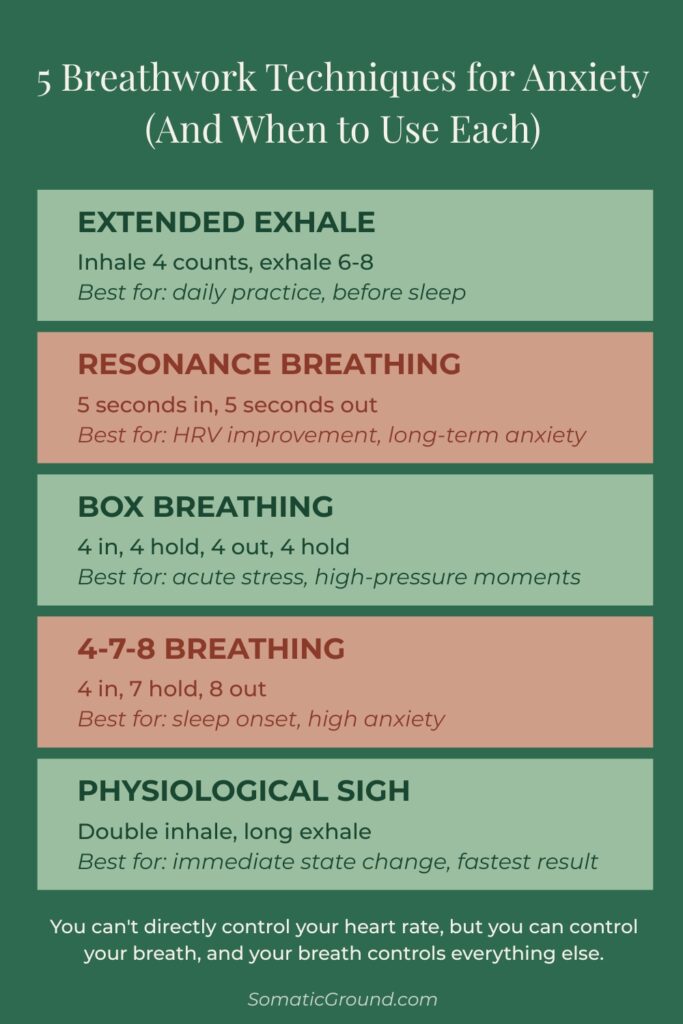
Extended exhale breathing The most fundamental and most supported. Inhale for 4 counts, exhale for 6-8. That’s it. Do it for five to ten minutes, preferably lying down or sitting still. The specific counts matter less than the ratio. Exhale longer than inhale.
Resonance frequency breathing Five to six breaths per minute, which works out to roughly five seconds in and five seconds out. Takes some practice to slow down to this rate if you’re used to a faster rhythm. The research on HRV and anxiety reduction at this rate is among the strongest in the breathwork literature.
Box breathing Four counts in, four hold, four out, four hold. Useful for acute stress situations where you need something structured and easy to remember. Popular in performance and military contexts for this reason.
4-7-8 breathing Four counts in, seven hold, eight out. Effective for many people before sleep or during high anxiety. Not suitable for people with respiratory conditions due to the extended hold.
Physiological sigh A double inhale through the nose followed by a long exhale through the mouth. Research from the Huberman Lab at Stanford has shown this produces faster parasympathetic activation than any other single breath pattern. The double inhale fully inflates the alveoli and the extended exhale produces rapid CO2 release and vagal activation. Useful for immediate state change when you need something fast.
Building a practice
The most common reason breathwork doesn’t work for people is inconsistency. They try it during a panic attack, find it mildly helpful, and don’t do it again until the next panic attack. The nervous system doesn’t update from occasional use.
A useful starting point: five minutes of extended exhale breathing before bed, every night for four weeks. It fits into an existing routine, costs nothing, and is long enough to produce measurable HRV improvement in the research at that duration and consistency. Once that’s habitual, adding a second five-minute session in the morning builds the benefit significantly.
The physiological sigh is worth keeping available for acute moments. Two double inhales and a long exhale, done anywhere, takes about fifteen seconds and produces a rapid state shift. It’s the most accessible immediate intervention and doesn’t require finding a quiet spot or closing your eyes.
For people who want to go deeper into the science and practice, James Nestor’s Breath is the most readable account of breathing research available for a general audience. It covers both the dysfunction that chronic mouth breathing and poor breathing mechanics produce and the evidence for what better breathing does.
A note on breathwork and trauma
For some people, particularly those with trauma histories, focused attention on breathing can be activating rather than regulating. The breath can become a trigger rather than a resource if it’s associated with past experiences of suffocation, drowning, or respiratory distress.
If breathwork feels anxiety-provoking rather than calming, that’s useful information rather than a sign it won’t work. Starting with very short sessions, keeping the eyes open, and working with a somatic therapist who can support nervous system regulation in the session are all worth considering. For this population, the external vagal stimulation of a device like Sensate may be a more accessible entry point than breath-focused practice.
Read next
- What Is the Vagus Nerve and Why Does It Matter?
- How to Stimulate Your Vagus Nerve at Home: 12 Science-Backed Ways
- 5 Somatic Grounding Exercises for Anxiety
SomaticGround.com explores the science of the nervous system and its connection to relationships, healing, and the embodied life. All content is for educational purposes and is not a substitute for professional medical or psychological care.