

Polyvagal Theory Explained: What It Means for Your Relationships
This post contains affiliate links. If you buy something through one of them, we may earn a small commission — at no extra cost to you. We only recommend things we'd genuinely stand behind.
Why your nervous system has three gears, and why the one you’re in determines everything.

Polyvagal Theory has become one of those terms that gets thrown around a lot in therapy offices and wellness content without anyone fully explaining what it actually means. Which is a shame, because it’s one of the more genuinely useful frameworks for understanding why you behave the way you do in relationships, especially under stress.
This is an attempt to explain it clearly, without oversimplifying it into uselessness.
Where it came from
Polyvagal Theory was developed by neuroscientist Stephen Porges in the 1990s. Porges was studying the autonomic nervous system, specifically the vagus nerve, and noticed something that existing models hadn’t accounted for: the vagus nerve isn’t one thing. It has two distinct branches, and they do very different jobs.
This led him to propose a three-tiered model of how the nervous system responds to threat and safety. The “poly” in polyvagal refers to those multiple vagal pathways. The theory describes how each pathway evolved, what it does, and crucially, how they interact with our capacity for connection.
The three states
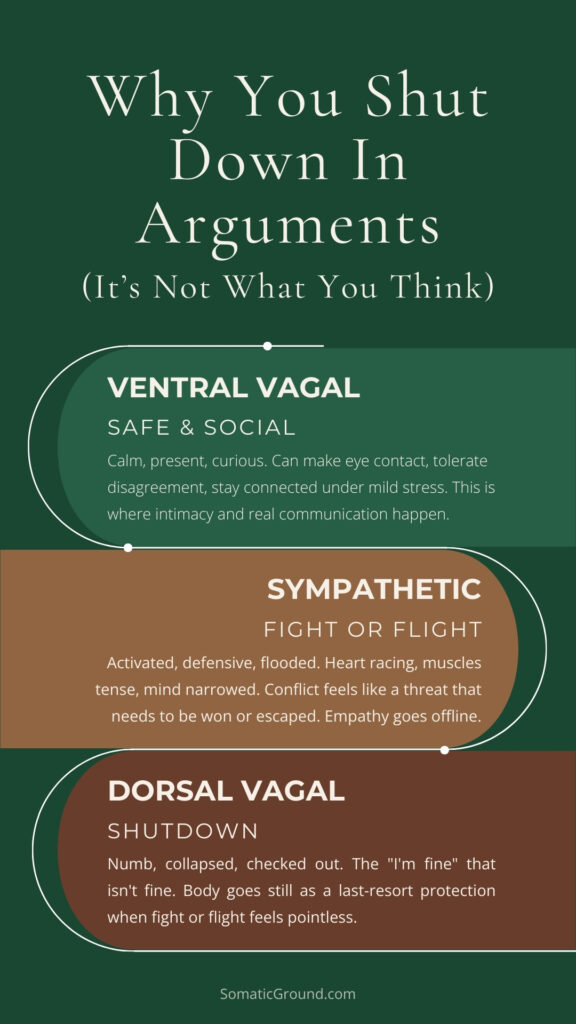
Think of these as a hierarchy, with the newest evolutionary development at the top and the oldest at the bottom. Under normal conditions, the top state runs the show. Under threat, the system moves down.
Ventral vagal: safe and social
This is the newest branch of the vagus nerve, found only in mammals. When you’re in a ventral vagal state, your nervous system is registering safety. You feel calm, present, and curious. Your facial muscles are expressive, your voice has natural prosody, your middle ear is tuned to pick up human speech. You can make eye contact, tolerate disagreement, and stay in contact with another person even when things get hard.
This is the state from which genuine connection, intimacy, and collaborative conflict resolution are possible. It’s also the state most people are trying to get back to when they talk about regulation.
Sympathetic: mobilized for action
When the nervous system detects threat, it mobilizes. The sympathetic nervous system ramps up, heart rate increases, muscles tense, digestion pauses, attention narrows. This is the fight-or-flight response most people are familiar with.
In relationships, sympathetic activation looks like: raised voice, defensive posture, flooding, the feeling that you need to win the argument or get out of the room. The prefrontal cortex, responsible for nuance, empathy, and perspective-taking, goes partly offline. You’re not at your most reasonable. Neither is your partner.
This state evolved for genuine physical threat, a predator, a rival, a hostile stranger. It does not distinguish well between a lion and a partner who used a certain tone of voice.
Dorsal vagal: shutdown
This is the oldest pathway, shared with reptiles and other vertebrates. When threat is perceived as inescapable or overwhelming, the system stops trying to fight or flee and instead shuts down. Heart rate drops, breathing becomes shallow, the body goes still. In animals this looks like playing dead. In humans it can look like dissociation, emotional numbness, collapse, the feeling of not being fully present in your own body.
In relationships, dorsal shutdown often gets misread. The person who goes quiet in a fight, who seems to check out, who says “I’m fine” in a flat voice, is often not being passive-aggressive. They’re in a shutdown state their nervous system moved into because it felt like the safest option available.
Neuroception: your body’s threat detector
One of Porges’s most important contributions is the concept of neuroception, the nervous system’s continuous, unconscious scanning of the environment for signals of safety or danger. This happens below conscious awareness, faster than thought.
Your nervous system is picking up cues from voices, faces, posture, proximity, sound frequencies, and the internal state of your own body, and making constant assessments. Safe or not safe. Connect or defend.
The important thing about neuroception is that it can be wrong. A nervous system shaped by early threat, by trauma, by chronic stress, can fire threat responses in situations that are objectively safe. Your partner raises their voice slightly because they’re excited, not angry, and your system moves into sympathetic activation before your conscious mind has registered what happened. By the time you’re aware of it, you’re already defending.
This is not a character flaw. It’s a calibration issue.
What this means for your relationships
Most relationship conflict that feels irresolvable is two nervous systems that have moved out of ventral vagal and lost access to the capacities that make repair possible: empathy, perspective-taking, the ability to hear what someone is actually saying rather than what threat your system has interpreted them as communicating.
You can’t think your way back into ventral vagal once you’re out of it. The cortex doesn’t have that kind of authority over the older parts of the system. What you can do is work with the body, slow the breath, change your posture, shift your environment, seek co-regulation with someone whose system is calmer than yours.
This is why taking a break during an argument actually works, not as avoidance, but as a physiological necessity. Twenty minutes is roughly how long it takes for stress hormones to clear enough to restore access to the prefrontal cortex. Coming back before that and trying to resolve things is often just continuing the fight with slightly different words.
It’s also why the nervous system state of both people in a relationship matters so much. Two people who are both chronically dysregulated, for whatever reason, will have a much harder time co-regulating each other. It’s not about compatibility in the conventional sense. It’s about whether both systems can, often enough, find their way back to safe and social together.

Working with the model practically
Polyvagal Theory isn’t just a framework for understanding what goes wrong. It’s a practical map for working with the nervous system intentionally.
Learning to identify which state you’re in, in real time, is a skill worth developing. Not just in retrospect (“I was clearly dysregulated in that conversation”) but in the moment. What does your body feel like in ventral vagal versus sympathetic? What are your personal early warning signs that you’re moving into shutdown?
Somatic therapists often work with this directly. If you’re interested in that kind of support, Online-Therapy.com has therapists trained in somatic and attachment-focused approaches (use code THERAPY20 for 20% off). Deb Dana, who trained directly with Porges, has written two accessible books on applying the theory practically: The Polyvagal Theory in Therapy and Anchored, the latter being more of a self-help guide and a good place to start.
The bigger point
What Polyvagal Theory offers, more than anything, is a way of understanding human behavior that is neither blaming nor naive. People don’t shut down in arguments because they don’t care. People don’t get flooded and say things they regret because they’re bad partners. These are nervous systems doing what nervous systems do, running ancient programs in modern situations.
That doesn’t mean nothing can change. It means the change has to go through the body, not just the mind. And that the goal isn’t perfect regulation, it’s enough flexibility to find your way back.
Read next
- Anxious Attachment and the Nervous System: What’s Actually Happening
- Signs Your Nervous System Is Dysregulated
- Why Your Nervous System Shuts Down in Arguments
SomaticGround.com explores the science of the nervous system and its connection to relationships, healing, and the embodied life. All content is for educational purposes and is not a substitute for professional medical or psychological care.