

Emotional Flashbacks: What They Are and How to Handle Them
This post contains affiliate links. If you buy something through one of them, we may earn a small commission — at no extra cost to you. We only recommend things we'd genuinely stand behind.
Unlike trauma flashbacks, emotional flashbacks don’t come with images or memories. Just a feeling, and it’s overwhelming.

You’re fine and then you’re not. There’s no obvious reason. Nothing dramatic has happened, but something, like a tone of voice, a look, a particular silence, a smell, or a time of year, has triggered a shift in state that feels completely disproportionate to whatever just occurred. You’re flooded with shame, or terror, or grief, or rage, or a formless dread you can’t name. You feel small in a very specific way. You might dissociate, or you might feel more intensely present than you’d like to be.
If you’ve experienced this and couldn’t explain it, it has a name. Pete Walker, who developed the concept, calls it an emotional flashback.
What an emotional flashback is
Most people understand trauma flashbacks as vivid re-experiencing of a traumatic event. They can include images, sounds, or the sense of being back in the original experience. Emotional flashbacks work differently. There’s no movie playing and no specific memory surfaces. What comes instead is the emotional and physiological state of the original experience, without the context that would make sense of it.
The body is reliving something the conscious mind isn’t being shown.
This happens because traumatic emotional states are stored in the nervous system and can be retriggered by anything that bears enough resemblance, such as in sensation, context, relational dynamic, or environmental cue, to the original experience. The amygdala pattern-matches faster than conscious thought and activates the stored response before the cortex has had time to assess whether the current situation actually warrants it.
The result is a feeling that seems to have arrived from nowhere, disproportionate to the present moment, carrying a quality that belongs to an earlier time even if you can’t identify which one.
How to recognise one
Emotional flashbacks can be hard to identify in the moment precisely because they feel completely real and present-tense. A few markers that suggest you might be in one rather than responding to something that’s actually happening now:
The intensity is out of proportion. The feeling is bigger than the situation warrants, and some part of you knows this even while feeling it completely.
There’s a quality of regression. You feel younger than you are. The smallness, the helplessness, or the shame has a childhood texture to it even if nothing about the current situation involves childhood.
The feeling came on suddenly and without obvious cause. You were fine and then you weren’t, and tracing back through the previous few minutes doesn’t produce a clear enough explanation for the shift.
Shame is often present, even when the situation doesn’t logically call for it. Shame is one of the most common emotional flashback states, particularly for people whose early experiences involved being made to feel fundamentally wrong or too much.
Your thinking becomes more primitive. The nuance and perspective-taking that you have access to in a regulated state disappear. Everything feels more black and white, more catastrophic, more certain.
The nervous system underneath
What’s happening physiologically in an emotional flashback is essentially the same as what happens in any trauma response: the amygdala has detected a pattern match with past threat and activated the stress response. The sympathetic system ramps up, or the dorsal vagal system shuts down, or both happen in rapid succession.
The difference from a more typical stress response is that the trigger is often invisible. It could be a micro-expression, a tone of voice, or something in the quality of a silence, and the response is calibrated to an old threat rather than a current one. The nervous system is running a program from the past in the present, with full conviction.
The prefrontal cortex, which could provide context and perspective, is partly offline because the activation is too high. This is why talking yourself out of an emotional flashback rarely works in the acute phase. The part of the brain that could receive that argument isn’t fully available.
What to do during one
The goal in the acute phase isn’t to understand the flashback. It’s to get the nervous system enough signal of present-moment safety that the activation can begin to reduce.
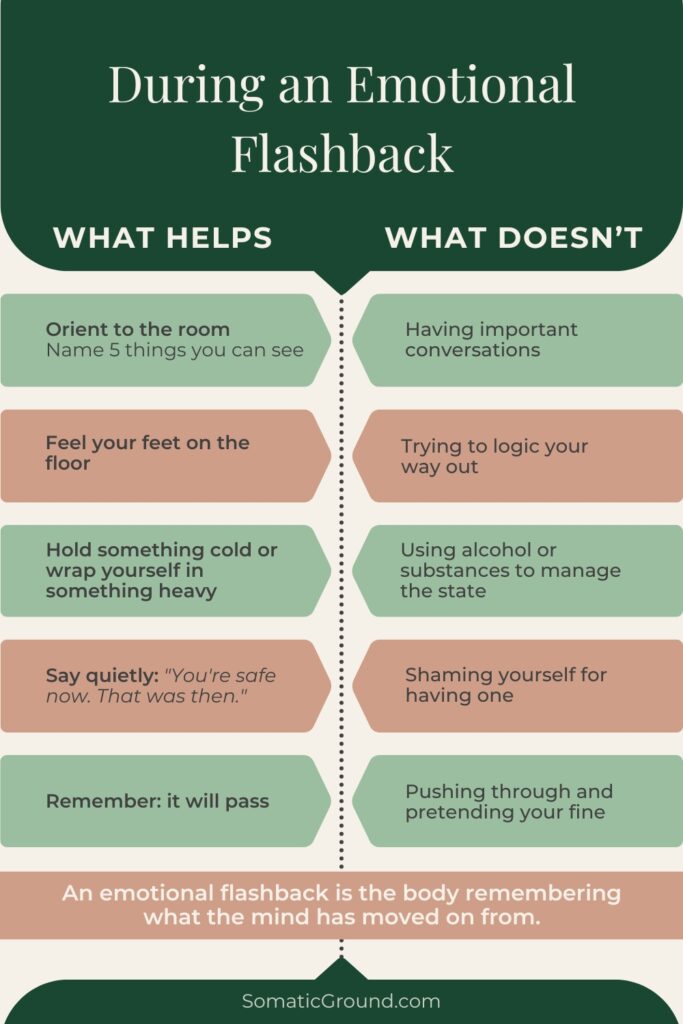
Orienting helps. Slowly looking around the room and naming five things you can see. Not internally, but preferably spoken aloud, even quietly. It engages the social engagement system and pulls attention into the present physical environment. The voice, used gently, activates vagal pathways. Looking around signals to the threat-detection system that the environment is being assessed and found safe.
Temperature and sensation help. Holding something cold, feeling your feet on the floor, or wrapping yourself in something heavy. These pull the nervous system into the present body rather than the activated state. The grounding techniques covered in our somatic grounding article apply directly here.
Self-talk, if possible, should be directed at the younger part of you that the flashback has activated rather than at the adult trying to logic their way out. Something like “you’re safe now, that was then”, said internally or aloud, speaks to the state rather than past it. This feels strange and can feel ineffective until it starts working, which it does, gradually.
Time. Emotional flashbacks pass. The nervous system doesn’t stay at peak activation indefinitely. Knowing it will pass, even when it doesn’t feel like it will, is itself a form of grounding.
What not to do
Don’t try to have important conversations while in a flashback state. Anything said to a partner, family member, or colleague while in the acute phase of an emotional flashback is coming from the activated, past-referencing state rather than the present-moment adult. This is how flashbacks damage relationships. Not the flashback itself, but the responses made from within it.
Don’t use substances to manage the state. Alcohol in particular provides temporary relief while deepening the underlying dysregulation and making future flashbacks more likely.
Don’t shame yourself for having one. Emotional flashbacks are a nervous system response to real experiences that the body has stored. They’re not a sign of weakness, irrationality, or being too much. They’re a sign that something happened that the nervous system hasn’t fully processed yet.
The longer work
Managing emotional flashbacks in the moment is a skill worth developing. The deeper work is reducing their frequency and intensity over time, which requires addressing the underlying material that’s being retriggered.
This is work that benefits significantly from therapeutic support. Pete Walker’s model of working with emotional flashbacks, developed in his book Complex PTSD: From Surviving to Thriving, is one of the most practical frameworks available. He identifies fourteen steps for managing flashbacks, developed through his own experience and clinical work, and the book is worth reading for anyone who recognises this pattern in themselves.
Somatic therapy, EMDR, and attachment-focused approaches all work with the underlying material in different ways. Online-Therapy.com has therapists trained in trauma-informed and somatic approaches if you want to work with someone on this. Use code THERAPY20 for 20% off.
Body-based regulation practice builds the nervous system flexibility that makes flashbacks less frequent and less overwhelming over time. Not because it processes the underlying material, but because a wider window of tolerance means the activation is less total when it happens. The practices covered throughout this site are all relevant here.
A note on relationships
Emotional flashbacks complicate close relationships in specific ways. The person in the flashback is responding to something from the past in the present, which means their partner is often confused, hurt, or defensive about a response that seems disproportionate or inexplicable.
Understanding the mechanism, that a flashback is a nervous system event rather than a character statement or an accurate read of the current situation, is useful for both people. For the person experiencing flashbacks, communicating about them outside of the acute phase (“sometimes I get into states where old feelings get retriggered and I lose perspective. When that happens I need a few minutes before I can talk”) reduces the relational damage they cause. For their partner, understanding that the response isn’t entirely about them is often a significant relief.
Read next
- How Childhood Trauma Shapes Your Nervous System and Relationships
- Signs Your Nervous System Is Dysregulated
- 5 Somatic Grounding Exercises for Anxiety
SomaticGround.com explores the science of the nervous system and its connection to relationships, healing, and the embodied life. All content is for educational purposes and is not a substitute for professional medical or psychological care.