

How Your Attachment Style Affects Your Nervous System
This post contains affiliate links. If you buy something through one of them, we may earn a small commission — at no extra cost to you. We only recommend things we'd genuinely stand behind.
The label is the least interesting part. Here’s what’s happening in your body.

Most people encounter attachment theory through a quiz. You answer a dozen questions about how you behave in relationships, get assigned a label, anxious, avoidant, secure, and walk away thinking you’ve learned something useful. Sometimes you have. But the label is the least interesting part.
What the quiz doesn’t tell you is that your attachment style isn’t just a psychological pattern. It’s a physiological one. It lives in your nervous system, in the way your body responds to closeness, conflict, and the threat of losing someone. Understanding that changes how you work with it.
Where attachment styles come from
Attachment theory was developed by British psychiatrist John Bowlby in the mid-20th century, later expanded by researcher Mary Ainsworth. The core idea is that humans are wired for connection from birth, and the quality of our earliest bonds shapes how we relate to people for the rest of our lives.
This isn’t about blame. A caregiver doesn’t have to be abusive or neglectful to produce an insecure attachment style. They just have to be inconsistently available, emotionally distant, or overwhelmed in ways that made closeness feel unreliable or unsafe to a developing child.
The child’s nervous system adapts. It learns a set of strategies for getting needs met, or for protecting itself when needs can’t be met. Those strategies become automatic. And they tend to show up, decades later, in your most intimate relationships.
The four styles, briefly
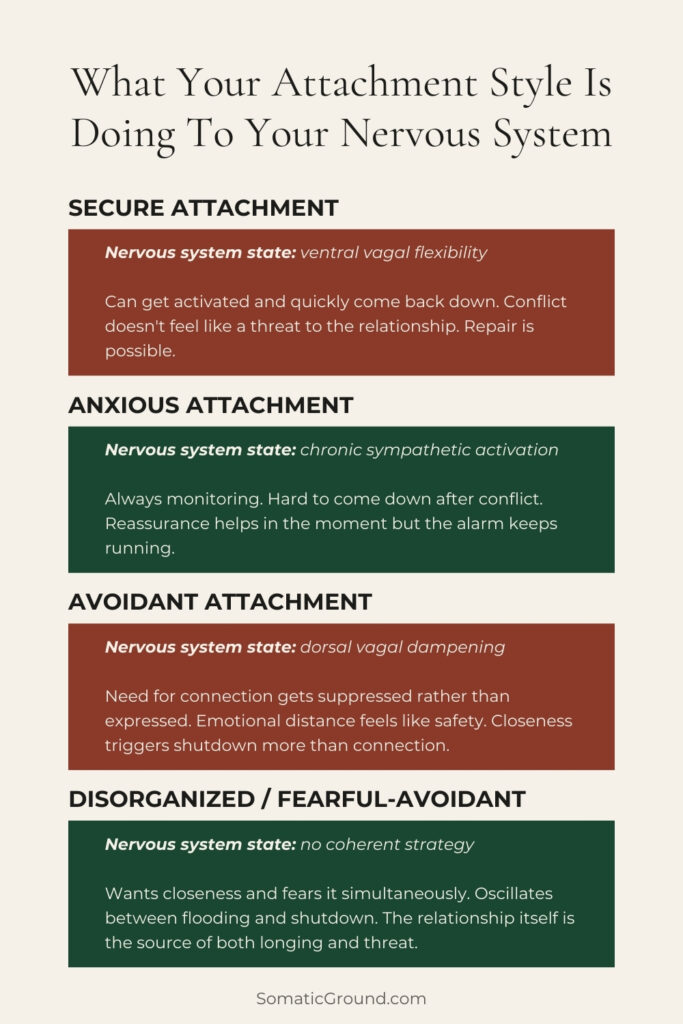
Secure attachment develops when caregivers are consistently responsive. The nervous system learns that closeness is safe, that needs can be expressed, and that repair is possible after conflict. Securely attached adults tend to have more flexible nervous systems. They’re not immune to stress in relationships, but they recover from it.
Anxious attachment develops when caregiving is inconsistent, warm sometimes, unavailable other times, with no reliable pattern. The child’s nervous system learns to stay hypervigilant, monitoring constantly for signs of withdrawal or rejection. In adult relationships this shows up as preoccupation with the relationship, fear of abandonment, and a nervous system that stays activated long after a conflict has nominally resolved.
Avoidant attachment develops when emotional needs are met with dismissal or discomfort, when closeness itself feels like too much. The nervous system learns to suppress attachment needs rather than express them, and to value self-sufficiency above connection. Avoidant adults often read as cool or independent, but underneath there’s a nervous system that learned early that needing people is risky.
Disorganized (or fearful-avoidant) attachment develops when the caregiver is also the source of fear, through abuse, severe unpredictability, or unresolved trauma in the parent that bleeds into the relationship. The child ends up in an impossible bind: the person who should be the safe haven is also the threat. The nervous system has no coherent strategy. In adult relationships this tends to produce simultaneous longing for and fear of intimacy.
What’s actually happening in your body
Here’s where it gets concrete.
Your attachment system and your nervous system are not separate things. They share the same hardware. The ventral vagal complex, the branch of the vagus nerve that Stephen Porges identified as central to social engagement, is what allows you to feel safe enough to connect. When it’s online, you can be present, curious, and open with another person. When it goes offline, connection starts to feel threatening rather than nourishing.
Anxious attachment is largely a story of sympathetic nervous system activation. The body is in a low-grade state of alarm, scanning for signs of threat to the relationship. Cortisol and adrenaline stay elevated. The mind loops. Sleep can be difficult. This isn’t anxiety as a mood, it’s anxiety as a physiological state that the nervous system has learned to maintain because it once made sense to do so.
Avoidant attachment is often a story of the opposite, what Porges calls the dorsal vagal state, a kind of shutdown or numbing. Rather than ramping up, the system learned to damp down. Avoidant people often describe feeling very little in emotionally charged moments, not because they don’t care, but because their nervous system learned that emotional activation was dangerous and developed a very effective off switch.
Disorganized attachment sits in both at once, or oscillates between them rapidly. One moment flooded, the next gone. It’s exhausting to live in and confusing to be in relationship with.
Why this matters for how you relate
Two people in a relationship bring two nervous systems. Those systems interact constantly, often below conscious awareness.
An anxious partner whose system is activated will often trigger the avoidant partner’s shutdown response, which in turn confirms the anxious partner’s fear of abandonment, which increases their activation, which deepens the avoidant partner’s withdrawal. This is the anxious-avoidant cycle, and it’s not primarily a communication problem. It’s a nervous system problem. Telling two people in that dynamic to “just talk it out” is a bit like telling someone to think their way out of a panic attack.
This is also why insight alone doesn’t change attachment patterns. You can know your style, understand where it came from, even feel compassionate toward it, and still find your nervous system doing the exact same thing it always did the moment someone you love pulls away. Knowledge lives in the cortex. Attachment patterns live much deeper.

What actually shifts things
Change happens through the body, through new experience, and through relationships that offer something different from what was learned early.
Therapy, particularly somatic or attachment-focused approaches, works partly because the therapeutic relationship itself is a corrective experience. A therapist who stays regulated, consistent, and attuned over time is giving the nervous system new data: closeness is safe, ruptures can be repaired, needs can be expressed without the relationship collapsing. Online-Therapy.com is worth looking at if you want to work with a therapist who specializes in this area without the barrier of finding someone local. Use code THERAPY20 for a 20% discount.
Somatic practices that build nervous system flexibility help too, not because they fix attachment patterns directly, but because a more regulated nervous system is better able to take in new experiences rather than filtering everything through old threat-detection. The vagus nerve work described in our first article applies here.
Secure relationships, romantic or otherwise, are genuinely therapeutic. Researchers call this earned secure attachment: adults who started with insecure styles and moved toward security over time, largely through sustained contact with people who were reliably safe. It takes time. It does happen.
For reading, Stan Tatkin’s Wired for Love is one of the clearest books on attachment and the nervous system in relationship, written for a general audience. Sue Johnson’s Hold Me Tight covers similar ground from an emotionally focused therapy perspective.
A note on labels
Attachment styles exist on a spectrum and most people are a mix. They also shift across different relationships and across your life. Knowing your style is a starting point, not a verdict. The point isn’t to locate yourself on a map and stay there. It’s to understand what your nervous system learned and start giving it opportunities to learn something new.
That’s slower than a quiz. It’s also more real.
Read next
- Polyvagal Theory Explained: What It Means for Your Relationships
- Anxious Attachment and the Nervous System: What’s Actually Happening
- Why Your Nervous System Shuts Down in Arguments
SomaticGround.com explores the science of the nervous system and its connection to relationships, healing, and the embodied life. All content is for educational purposes and is not a substitute for professional medical or psychological care.