

Anxious Attachment and the Nervous System: What’s Actually Happening
This post contains affiliate links. If you buy something through one of them, we may earn a small commission — at no extra cost to you. We only recommend things we'd genuinely stand behind.
Knowing you’re anxiously attached doesn’t make the anxiety stop. Here’s why, and what does.

If you have anxious attachment, you’ve probably spent a fair amount of time wondering why you can’t just relax in relationships. You know, intellectually, that your partner loves you. You know the last argument wasn’t actually a sign that everything is falling apart. You know you’re probably reading too much into that text response time.
Knowing doesn’t help. The worry keeps going. The body keeps bracing.
There’s a physiological reason for that, and understanding it tends to be more useful than trying to logic yourself out of something that isn’t primarily a logical problem.
What anxious attachment actually is
Anxious attachment, sometimes called preoccupied attachment in the research literature, develops when early caregiving is inconsistent. Not necessarily harmful, just unreliable. Sometimes the caregiver is warm and attuned. Sometimes they’re distracted, stressed, or emotionally unavailable. The child has no way of predicting which version they’ll get.
The nervous system responds to unpredictability the same way it responds to threat: by staying alert. If you can’t predict when safety is coming, the safest strategy is to never stop monitoring for it. Hypervigilance becomes the baseline. The attachment system stays switched on because switching it off, relaxing, trusting that things are okay, has previously meant missing the moment when they weren’t.
This isn’t a decision. It’s an adaptation. And it’s one that tends to follow people directly into adult relationships.
The nervous system mechanics
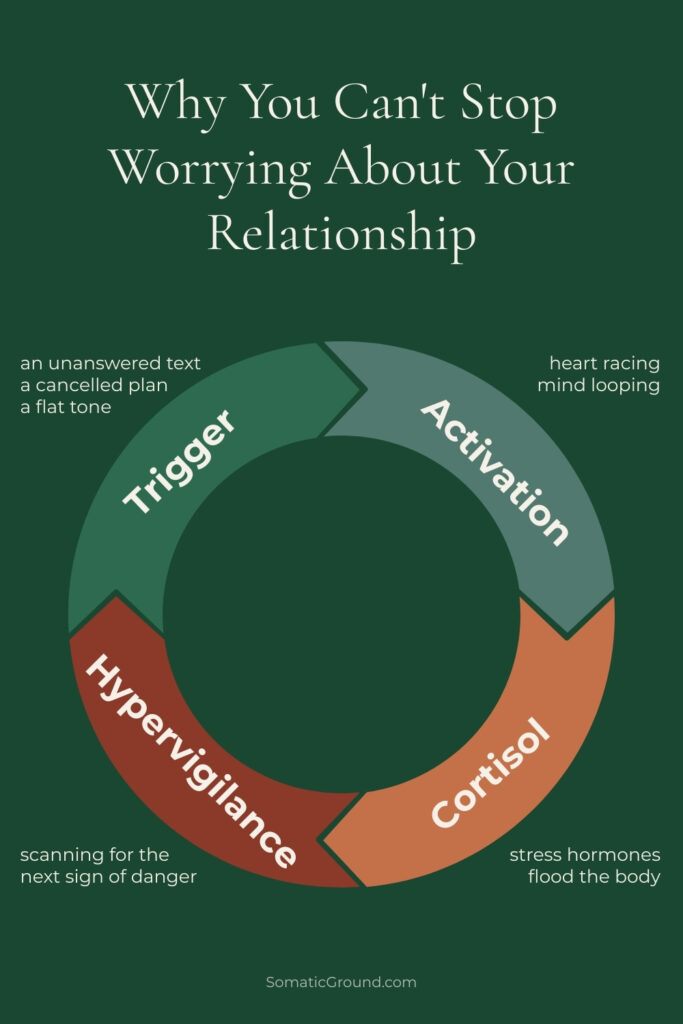
Anxious attachment is largely a sympathetic nervous system pattern. People with anxious attachment tend to have lower heart rate variability, meaning their nervous system is less flexible, less able to move smoothly between activation and rest. They also tend toward higher baseline cortisol, the body’s primary stress hormone.
In practical terms this means the nervous system is running hotter than it needs to, more often, and for longer after a trigger than the situation would seem to warrant. An unanswered message can produce a cortisol response. A partner’s slightly flat tone can move the system into fight-or-flight. And once activated, calming down takes longer because the regulatory system, the parasympathetic brake mediated by the vagus nerve, has been chronically underused relative to the accelerator.
The prefrontal cortex, responsible for perspective-taking and the ability to hold multiple possibilities at once (“maybe they’re just busy”), is also less accessible when the sympathetic system is dominant. Which is why reassurance helps in the moment but rarely resolves anything long-term. The nervous system isn’t asking for information. It’s in a state. States don’t respond well to facts.
What it feels like from the inside
The experience of anxious attachment in a relationship tends to involve some combination of:
A near-constant background monitoring of the relationship’s temperature. Is everything okay? Are they still as engaged as they were yesterday? Did that comment mean something?
An outsized response to signs of distance, real or perceived. A cancelled plan, a slower text response, a partner who seems quieter than usual can feel like early warning signs of abandonment rather than just ordinary life.
Difficulty self-soothing. The nervous system has learned to regulate through proximity to the attachment figure, through co-regulation, rather than developing robust internal regulation strategies. When the attachment figure is the source of distress, there’s nowhere comfortable to turn.
A cycle of protest behaviors followed by relief and then guilt. Calling repeatedly, pushing for reassurance, starting an argument partly to get a response, these behaviors make sense from a nervous system perspective even when they’re counterproductive relationally.
The anxious-avoidant dynamic
Anxious attachment tends to pair with avoidant attachment with some frequency, partly because each style has something the other seems to offer. The avoidant partner’s independence reads initially as security. The anxious partner’s warmth and pursuit reads initially as desired closeness.
Under stress the dynamic becomes self-reinforcing. The anxious partner’s activation triggers the avoidant partner’s withdrawal response. The withdrawal confirms the anxious partner’s fear. The increased activation increases the withdrawal. Nobody is being malicious. Two nervous systems are just doing what they learned to do.
Understanding the dynamic at this level, as two nervous system responses in interaction rather than one person being needy and another being cold, tends to reduce blame and open up more productive possibilities. It also clarifies why behavioral changes alone (“I’ll try not to text so much,” “I’ll try to be more present”) often don’t hold. The behavior is downstream of the state. The state is what needs to change.

What actually helps
Somatic practices that build nervous system flexibility. Breathwork, gentle movement, body-based grounding practices, anything that repeatedly activates the parasympathetic system and gives the nervous system experience of coming down from activation, gradually expands the window of tolerance. This doesn’t eliminate anxious responses but it makes recovery faster and the activation less overwhelming.
Therapy that works with the body and the attachment system directly. Standard talk therapy can provide insight, which is valuable, but insight doesn’t reliably change physiological patterns on its own. Somatic therapy, EMDR, and approaches like Emotionally Focused Therapy (EFT) work more directly with the nervous system and the relational patterns underneath the anxiety. Online-Therapy.com has therapists trained in these approaches and is more accessible than hunting for someone local. Use code THERAPY20 for 20% off.
Relationships that offer consistent, reliable safety over time. This is the hardest one to engineer, but it’s genuinely therapeutic. The nervous system learns safety through experience, not through reasoning. A relationship where repair happens reliably, where bids for connection are responded to, where the anxious person’s activation doesn’t produce the withdrawal they most fear, provides new data that gradually updates the old programming. Earned secure attachment is real and it comes primarily through this.
Sue Johnson’s Hold Me Tight is worth reading if you’re in a relationship and trying to understand these dynamics together. If you want to go deeper into the neuroscience of attachment and how it plays out in the body, Attached by Amir Levine and Rachel Heller remains one of the best accessible introductions to the research.
A word on self-compassion
Anxious attachment is easy to pathologize, including by people who have it. The self-criticism that often accompanies it (“why am I like this,” “I’m too much,” “I’m going to push everyone away”) is itself a stress response, another way the nervous system tries to manage fear of rejection by getting there first.
The pattern made sense when it developed. It was a child’s best available strategy for maintaining connection in an unpredictable environment. The fact that it now causes problems doesn’t make the person who developed it defective. It makes them human, adapted to a context that no longer exists, in a body that hasn’t fully gotten the news yet.
That’s not a reason to stay stuck. It’s just a more useful place to start from than shame.
Read next
- Polyvagal Theory Explained: What It Means for Your Relationships
- Why Your Nervous System Shuts Down in Arguments
- Co-Regulation: Why You Need a Calm Partner to Feel Safe
SomaticGround.com explores the science of the nervous system and its connection to relationships, healing, and the embodied life. All content is for educational purposes and is not a substitute for professional medical or psychological care.