

Nervous System Regulation for Highly Sensitive People
This post contains affiliate links. If you buy something through one of them, we may earn a small commission — at no extra cost to you. We only recommend things we'd genuinely stand behind.
Being highly sensitive isn’t a flaw in the nervous system. It’s a different calibration, and it comes with specific needs that most regulation advice doesn’t account for.

The term highly sensitive person, or HSP, was coined by psychologist Elaine Aron in the 1990s to describe people who process sensory and emotional information more deeply than average. Aron estimated that around 15-20% of the population falls into this category, and subsequent research has found similar traits across many animal species, suggesting it’s a genuine biological variation rather than a personality quirk or a pathology.
For highly sensitive people, the nervous system isn’t broken. It’s doing more processing than average, picking up more information from the environment, registering subtler cues, taking longer to move through experiences. The problem isn’t the sensitivity itself but the mismatch between that sensitivity and environments that aren’t designed for it, and the absence of specific regulation strategies that account for how an HSP nervous system actually works.
What makes a nervous system highly sensitive
Aron’s research identified four core characteristics she grouped under the acronym DOES: Depth of processing, Overstimulation, Emotional reactivity and empathy, and Sensitivity to subtleties.
Depth of processing is the central one. HSPs don’t just register more sensory information — they process it more thoroughly, making more connections, noticing more implications, sitting with experiences longer before moving on. This is the source of many HSP strengths, including creativity, empathy, conscientiousness, and the ability to pick up on things others miss, but it’s also why stimulating environments are more tiring and why decisions take longer and require more recovery time than they do for non-HSPs.
Overstimulation follows directly from deep processing. If you’re doing more with every piece of incoming information, you hit your processing limit faster. Loud environments, crowded spaces, time pressure, multitasking, and emotionally intense situations all load the system more heavily for an HSP than for someone with a less sensitive nervous system, and the resulting overwhelm is physiological rather than just subjective.
The nervous system of an HSP is not more fragile. It’s processing more, which means it needs more recovery time, more space to discharge what it’s taken in, and more intentional management of input levels.
What dysregulation looks like for an HSP
The dysregulation symptoms described in the signs of dysregulation article all apply, but highly sensitive people tend to experience them more quickly and more intensely than the general description suggests.
Overstimulation can arrive after events that would seem mild to others — a busy afternoon, a social gathering that ran long, a day with too many transitions. The nervous system isn’t being dramatic. It has genuinely processed more than a less sensitive one would have in the same time and needs proportionally more recovery.
Emotional contagion is often particularly pronounced. Because HSPs process emotional information more deeply, they tend to absorb the emotional states of people around them more readily. In a dysregulated group or relationship, an HSP’s nervous system can end up carrying activation that isn’t even theirs.
Sensory overwhelm, specific sensitivity to noise, light, texture, smell, or temperature, is common and can produce significant distress that looks disproportionate to others who aren’t registering the same input.
Cognitive overwhelm, the inability to think clearly, make decisions, or process new information after too much stimulation, is the HSP equivalent of running out of RAM. It’s not a mood. It’s a genuine processing limit that requires downtime rather than effort to resolve.
What regulation looks like for an HSP
The general principles of nervous system regulation all apply for HSPs, but the dosing and sequencing often need adjustment.
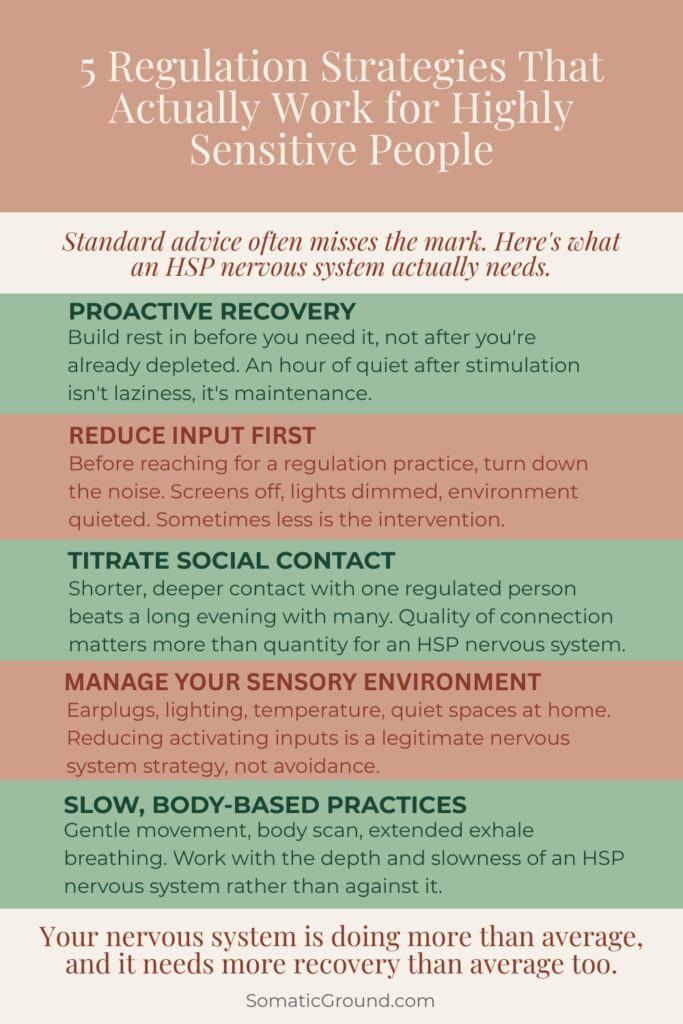
Proactive recovery rather than reactive repair. For most people, regulation practices are most useful when dysregulation has already occurred. For HSPs, building recovery time into the schedule before it feels necessary tends to be more effective. A quiet hour after a stimulating event, a period of solitude after socialising, transitions built into the day — these are not luxuries. They’re maintenance.
Reducing input before adding practice. The standard regulation advice tends to focus on adding practices: breathwork, meditation, movement. For an already overstimulated HSP, adding more to do can increase load rather than reduce it. Sometimes regulation looks like removing stimulation rather than doing something, turning off screens, reducing noise, being in a quiet space with nothing required, before any active practice is useful.
Titrating social contact. Social co-regulation is genuinely helpful for HSPs, as it is for everyone, but the dose matters more. Extended time with many people, or with people who are themselves highly activated, can leave an HSP more depleted than before. Shorter, more intimate contact with one regulated person tends to be more nourishing than larger social gatherings, even enjoyable ones.
Working with sensory environment. Identifying the sensory inputs that are most activating, and reducing them where possible, is a legitimate regulation strategy rather than avoidance. Wearing earplugs in loud environments, having a specific quiet space at home, managing lighting, and being selective about where time is spent are all practical nervous system management rather than oversensitivity.
Slow, body-based practices. Yoga, gentle movement, body scan meditation, and extended exhale breathing all suit the HSP nervous system well because they work with depth and slowness rather than against them. High-intensity exercise can be regulating but also more likely to tip into overwhelm for HSPs who are already activated.
For people wanting to understand their sensitivity more deeply, Elaine Aron’s The Highly Sensitive Person remains the most thorough account available, and her self-assessment tool on her website (hsperson.com) is worth taking if you’re unsure whether the concept applies to you. The Sensate device is particularly well-suited to HSPs who find breath-based practices hard to access when overstimulated, as it provides passive vagal stimulation without requiring additional cognitive effort.
HSP and relationship
High sensitivity affects relationships in specific ways that are worth naming.
HSPs tend to be particularly attuned to relational dynamics, picking up on subtle shifts in mood, unspoken tension, and the emotional states of partners and friends with considerable accuracy. This attunement can make them deeply empathic and perceptive partners, but it also means they’re carrying more relational information at any given time and are more affected by the nervous system state of the people they’re close to.
In relationships where a partner’s dysregulation is chronic, an HSP may find themselves absorbing and attempting to regulate someone else’s state in addition to their own, which is exhausting and ultimately unsustainable. Understanding co-regulation as a two-way process, and being honest about the need for relationships that offer genuine reciprocity in this regard, is particularly important for HSPs.
Partners of HSPs, for their part, benefit from understanding that sensitivity to noise, crowds, emotional intensity, and sensory input is not criticism of them or evidence of fragility. It’s a nervous system characteristic that requires accommodation rather than management.
Read next
- Signs Your Nervous System Is Dysregulated
- What Is the Window of Tolerance?
- 5 Somatic Grounding Exercises for Anxiety
SomaticGround.com explores the science of the nervous system and its connection to relationships, healing, and the embodied life. All content is for educational purposes and is not a substitute for professional medical or psychological care.