

The Neuroscience of Attachment Styles: What the Science Says
This post contains affiliate links. If you buy something through one of them, we may earn a small commission — at no extra cost to you. We only recommend things we'd genuinely stand behind.
Attachment theory started as psychology. The neuroscience has caught up, and what it shows is worth knowing.
Attachment theory has been around since the 1960s. For most of that time it was primarily a psychological framework, based on observational research with infants and caregivers. The neuroscience tools to look inside the living brain simply didn’t exist yet.
That’s changed considerably over the past few decades. Neuroimaging, stress hormone research, and autonomic nervous system studies have given researchers a much clearer picture of what’s actually happening biologically when attachment patterns play out. The findings don’t overturn what the psychological research established. They explain the mechanism underneath it.
The brain systems involved in attachment
Attachment draws on several interconnected brain systems rather than a single structure.
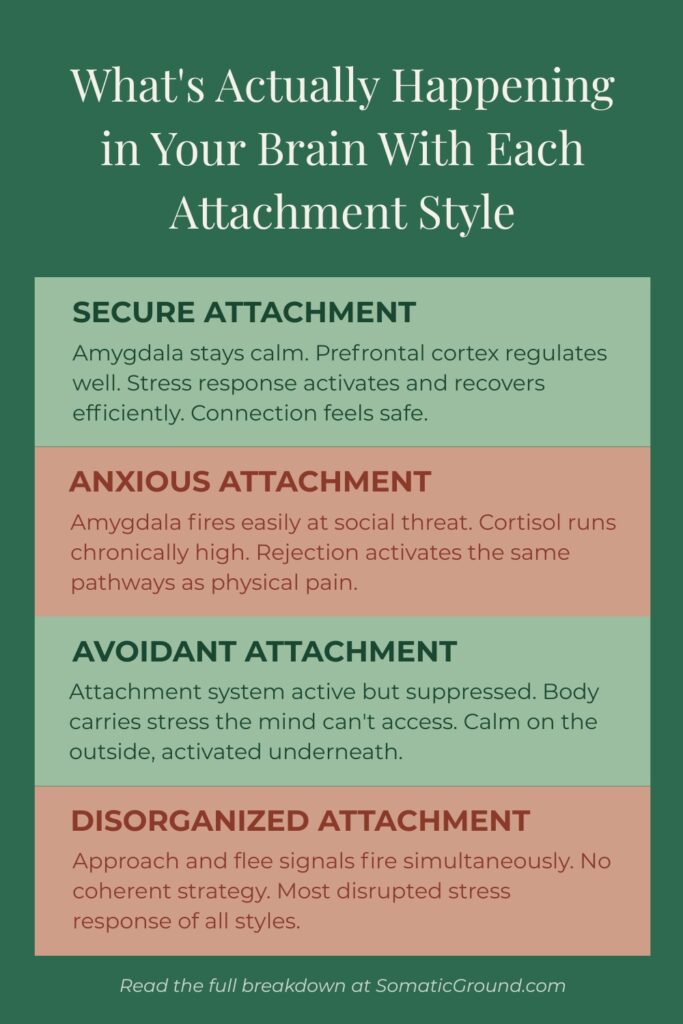
The amygdala, the brain’s threat-detection centre, plays a central role. It processes whether the people around us are safe or dangerous, whether their facial expressions signal warmth or hostility, whether proximity is something to seek or avoid. In people with insecure attachment, particularly anxious and disorganized styles, the amygdala tends to be more reactive, firing threat responses to social stimuli that securely attached people process as neutral or positive.
The prefrontal cortex, responsible for regulation, perspective-taking, and the ability to hold multiple interpretations of a situation, acts as a brake on amygdala reactivity. Secure attachment is associated with better prefrontal regulation of the amygdala response. Insecure attachment, particularly when it developed in the context of significant adversity, is associated with a less effective prefrontal brake.
The hypothalamic-pituitary-adrenal (HPA) axis, the body’s main stress response system, is calibrated in part by early attachment experiences. Research with both humans and animals shows that consistent, responsive early caregiving produces a more flexible, well-regulated HPA axis, meaning the stress response activates appropriately and recovers efficiently. Inconsistent or frightening early caregiving produces a more reactive and slower-recovering system.
The oxytocin system is involved in the subjective experience of attachment: the feeling of closeness, trust, and safety with a specific person. Oxytocin release during physical contact, eye contact, and attuned interaction reinforces attachment bonds and produces the neurological signature of felt safety.
What happens in the anxiously attached brain
In anxious attachment, the threat-detection system is calibrated toward social threat specifically. The amygdala fires more readily to signs of potential rejection or withdrawal, even ambiguous ones. Neutral expressions get read as negative. A slower text reply registers as early warning of abandonment.
Cortisol, the primary stress hormone, tends to be chronically elevated in people with anxious attachment, consistent with a system that’s spending significant energy monitoring for threat. The prefrontal cortex has a harder time reassuring the amygdala that the relationship is safe, partly because the early experience that calibrated the system didn’t provide enough reliable safety data to establish that expectation.
This also shows up in pain processing research. Studies using neuroimaging have found that social rejection activates some of the same neural pathways as physical pain in anxiously attached individuals, with the activation more pronounced than in securely attached people. The threat of losing attachment isn’t metaphorically painful. It’s neurologically proximate to physical injury.
What happens in the avoidantly attached brain
Avoidant attachment presents differently. Rather than heightened reactivity to social threat, the research shows evidence of active suppression of attachment-related neural activity.
Neuroimaging studies have found that people with avoidant attachment show reduced activation in attachment-related brain regions during tasks that activate these regions in securely attached people. They appear to be downregulating the neural response to attachment cues rather than not having the response. The attachment system is present and activates. It’s being inhibited.
This aligns with what the psychological research describes behaviourally: avoidant individuals haven’t extinguished their need for connection. They’ve learned to suppress the expression of it, and the neuroscience suggests this suppression has a biological correlate. The effort of maintaining that suppression under stress shows up as elevated physiological arousal in some studies, even when the behavioural presentation looks calm.
What happens in disorganized attachment
Disorganized attachment, the style that develops when the caregiver is also a source of fear, shows the most disrupted neurobiology of the four styles.
The fundamental conflict, approach the attachment figure or move away from the threat, produces what researchers call contradictory action tendencies at a neural level. Both the approach system and the avoidance system activate simultaneously with no resolution. This is associated with fragmented or dissociative processing in some studies, consistent with the clinical picture of disorganized attachment as a style without a coherent strategy.
HPA axis dysregulation tends to be most pronounced in disorganized attachment, as does structural differences in brain regions involved in stress regulation and emotional processing in people with significant early adversity. These findings come largely from research on severe neglect and abuse, so they represent the more extreme end of the spectrum rather than all disorganized attachment.
What secure attachment looks like neurobiologically
Secure attachment is associated with a more flexible, responsive nervous system across most of the measures that matter.
HPA axis reactivity is appropriate rather than excessive or blunted. The amygdala responds to genuine threat but doesn’t fire at ambiguous social stimuli. The prefrontal cortex provides effective regulation. Oxytocin systems function well, supporting the felt experience of safety in close relationships. HRV tends to be higher, consistent with better vagal tone and nervous system flexibility.
Importantly, this profile isn’t fixed at birth or determined solely by early experience. Earned secure attachment, the state that people who started with insecure attachment can move toward over time, shows a similar neurobiological profile in the research. The brain changes. The nervous system can update. The mechanisms are slower than insight and require different inputs, sustained experience of safe relationship rather than information, but the capacity for change is real and documented.
What this means practically
The neuroscience of attachment matters for one main reason: it explains why the patterns are so persistent and why they require more than insight to change.
If the amygdala has been calibrated to fire at social threat by years of experience, telling it rationally that the current relationship is safe doesn’t update the calibration. New experience does. Repeated contact with genuine safety, the kind that accumulates in a consistent therapeutic relationship, a genuinely secure partnership, a community that is actually trustworthy, is what gives the nervous system new data to work with.
This takes time. It’s not a linear process. And it tends to require support, because the patterns that need updating developed in relationship and the updating happens most effectively in relationship too.
For anyone wanting to go deeper on the research, Daniel Siegel’s The Developing Mind covers the neuroscience of attachment in more detail than most accessible books manage without losing the thread for non-academic readers. Sue Johnson’s Love Sense covers the neuroscience from a more relational and emotionally focused angle. Online-Therapy.com has therapists trained in attachment-focused approaches if you want to work with this directly. Use code THERAPY20 for 20% off.
Read next
- How Your Attachment Style Affects Your Nervous System
- Anxious Attachment and the Nervous System: What’s Actually Happening
- Fearful Avoidant Attachment and the Nervous System
SomaticGround.com explores the science of the nervous system and its connection to relationships, healing, and the embodied life. All content is for educational purposes and is not a substitute for professional medical or psychological care.