

Mindfulness and the Nervous System: What Actually Changes in the Brain
This post contains affiliate links. If you buy something through one of them, we may earn a small commission — at no extra cost to you. We only recommend things we'd genuinely stand behind.
Mindfulness has been oversold in some ways and undersold in others. Here’s what the research actually shows happens when you practice it consistently.

Mindfulness has had an interesting journey. It went from a contemplative practice with roots in Buddhist tradition to a clinical intervention with its own research base to a corporate wellness buzzword, all within a few decades. Along the way something got lost, which is that underneath the branding, the research on what consistent mindfulness practice actually does to the brain and nervous system is genuinely interesting and more specific than most accounts suggest.
The popular version tends toward either overclaim, such as mindfulness as a cure for everything, or dismissal, usually from people who tried an app for a week and felt nothing. The research sits somewhere more nuanced than either.
What mindfulness actually is
Before getting into the neuroscience it’s worth being clear about what mindfulness means in a research context, because the word covers a lot of ground in popular use.
In the clinical and research literature, mindfulness refers to the deliberate, non-judgmental attention to present-moment experience. It’s not relaxation, though relaxation sometimes follows. It’s not positive thinking or the absence of thought. It’s the practice of noticing what’s happening, in the body, in the mind, in the environment, without immediately reacting to it or getting pulled into narrative about it.
This distinction matters because the mechanism through which mindfulness produces its effects is attention regulation rather than relaxation, and understanding that changes how you practise and what you expect from it.
What changes in the brain
The neuroscience of mindfulness has developed considerably over the past two decades, with neuroimaging studies allowing researchers to look at structural and functional brain changes in long-term meditators compared to non-meditators, and in people before and after mindfulness training programmes.
The findings cluster around a few areas.
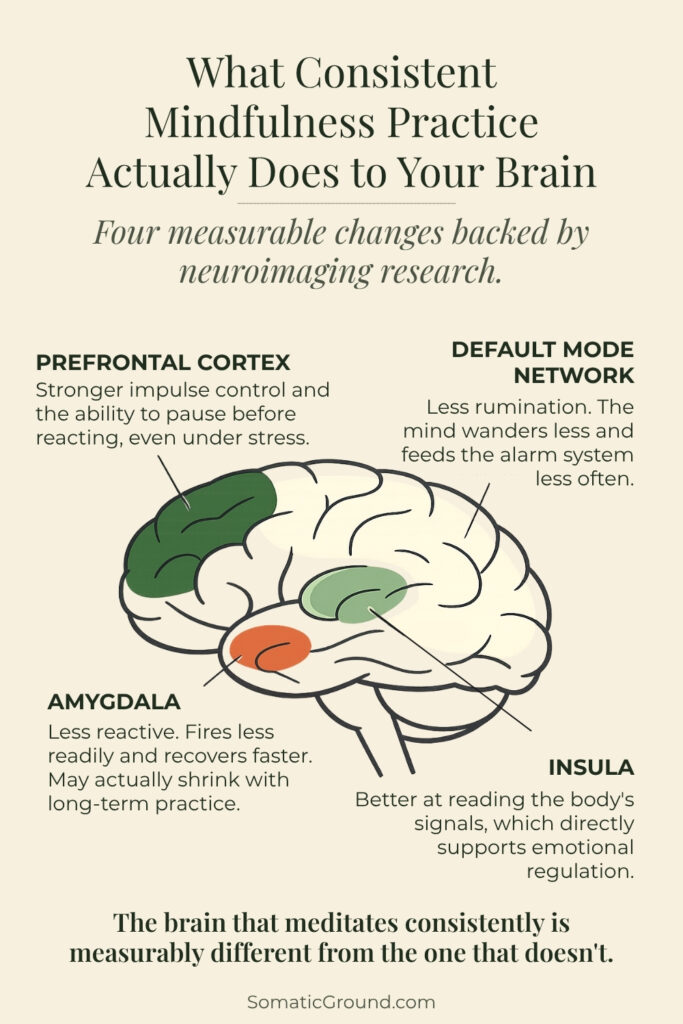
The prefrontal cortex. Regular mindfulness practice is associated with increased grey matter density in the prefrontal cortex, the region responsible for executive function, attention regulation, impulse control, and the capacity to pause before reacting. This is the part of the brain that goes partly offline during high activation states, and strengthening it through practice appears to improve its regulatory capacity over time, making it more available even under stress.
The amygdala. Multiple studies have found reduced amygdala reactivity in experienced meditators, meaning the threat-detection system fires less readily in response to stressors. Importantly, this isn’t just functional change, several studies have found reduced grey matter volume in the amygdala in long-term meditators, suggesting that consistent practice may actually shrink the threat-detection system over time.
The insula. The insula is central to interoception, the brain’s awareness of internal body states. Mindfulness practice consistently shows increased insula activation and, in long-term practitioners, increased grey matter in this region. Better interoceptive awareness means more accurate reading of the body’s signals, which is directly relevant to emotional regulation, since emotions are partly read from the body.
The default mode network. The default mode network is a set of brain regions that activate when the mind wanders, when we ruminate, replay the past, or anticipate the future. It’s associated with self-referential thought and is more active in depression and anxiety. Mindfulness practice reduces default mode network activity during practice and, in experienced meditators, appears to reduce its dominance even outside of formal practice.
What this means for the nervous system
The brain changes described above translate into nervous system effects that are measurable and relevant to the concerns of people reading the content we share here.
Improved HRV (Heart Rate Variability). Multiple studies have found higher resting HRV in regular meditators, consistent with better vagal tone and a more flexible autonomic nervous system. The effect is most pronounced in people who have been practising for longer and more consistently.
Reduced baseline cortisol. Mindfulness-Based Stress Reduction (MBSR), the most researched clinical mindfulness programme, consistently shows reductions in cortisol in participants, with effects that persist beyond the programme itself in people who maintain their practice.
Faster recovery from stress activation. Rather than eliminating stress responses, regular mindfulness practice appears to improve recovery, the nervous system activates in response to stress but returns to baseline more quickly. This is the window of tolerance widening through a different mechanism than the somatic practices covered elsewhere in this site, but producing similar results.
Reduced default mode network rumination. Since rumination is one of the primary drivers of sustained sympathetic activation, reducing it has direct nervous system effects. The mind stops feeding the alarm system with threat content as frequently, and the nervous system gets more opportunity to return to baseline.
What the research is more cautious about
Mindfulness research has significant limitations that the popular coverage tends to skip over.
Many studies have small samples, no active control groups, and high dropout rates. The comparison condition matters a lot: mindfulness often outperforms waitlist controls but performs more comparably to other active interventions like exercise or relaxation training, suggesting that some of the benefit is from doing something rather than from mindfulness specifically.
The neuroimaging findings on structural brain changes are exciting but require replication at larger scale. Some of the early findings haven’t held up as well as initially hoped.
And the enthusiastic deployment of mindfulness in contexts where it may be actively unhelpful, including for people with trauma histories where focused internal attention can be destabilising, has been a genuine problem that the field is now taking more seriously.
Mindfulness and trauma
This warrants its own section because it’s frequently mishandled in mindfulness content.
For people with significant trauma histories, turning attention inward and staying with present-moment body experience can activate rather than calm the nervous system. The body doesn’t feel like a safe place to be, and being asked to attend to it closely can trigger exactly the kind of activation that mindfulness is supposed to reduce.
This doesn’t mean mindfulness is wrong for people with trauma, but it means the standard instruction to close your eyes and focus on your breath is not always the right starting point. Eyes-open practice, shorter sessions, external rather than internal focus, and the guidance of a teacher or therapist who understands trauma are all adaptations worth knowing about.
Trauma-sensitive mindfulness, developed by David Treleaven, addresses this specifically and is worth reading about if this is relevant to your situation. His book Trauma-Sensitive Mindfulness covers both the why and the practical adaptations in accessible detail.
Building a practice that actually produces these effects
The brain changes described above don’t come from occasional mindfulness sessions. They come from consistent practice over months and years, and the dose matters more than most people want to hear.
The MBSR programme, which has the most robust evidence base, involves eight weeks of practice with around 45 minutes of formal practice per day, which is considerably more than a ten-minute app session. The research on shorter practice times shows benefits, but more modest ones, and the structural brain changes found in long-term meditators involve thousands of hours of cumulative practice.
That’s not a reason to do nothing if you can’t commit to 45 minutes daily. Shorter consistent practice is meaningfully better than no practice, and the HRV and cortisol effects show up at more accessible doses. But setting realistic expectations matters, and the version of mindfulness that produces dramatic neurological change is a sustained, serious practice rather than a morning routine add-on.
For people wanting to build a meaningful practice, Jon Kabat-Zinn’s Full Catastrophe Living is the foundational text on MBSR and gives the most complete account of both the practice and the evidence base behind it.
Read next
- What Is the Window of Tolerance?
- Heart Rate Variability: What It Is and How to Improve It
- Best Meditation Apps for Anxiety and Nervous System Health
SomaticGround.com explores the science of the nervous system and its connection to relationships, healing, and the embodied life. All content is for educational purposes and is not a substitute for professional medical or psychological care.