

Interoception: Why Body Awareness Is the Foundation of Emotional Intelligence
This post contains affiliate links. If you buy something through one of them, we may earn a small commission — at no extra cost to you. We only recommend things we'd genuinely stand behind.
Most emotional intelligence content focuses on the mind. The research suggests it starts in the body.

Emotional intelligence gets talked about mostly in terms of the mind. Recognizing emotions, managing them, and reading other people’s. The assumption embedded in most EQ content is that emotions are primarily mental events that can be understood and regulated through better thinking.
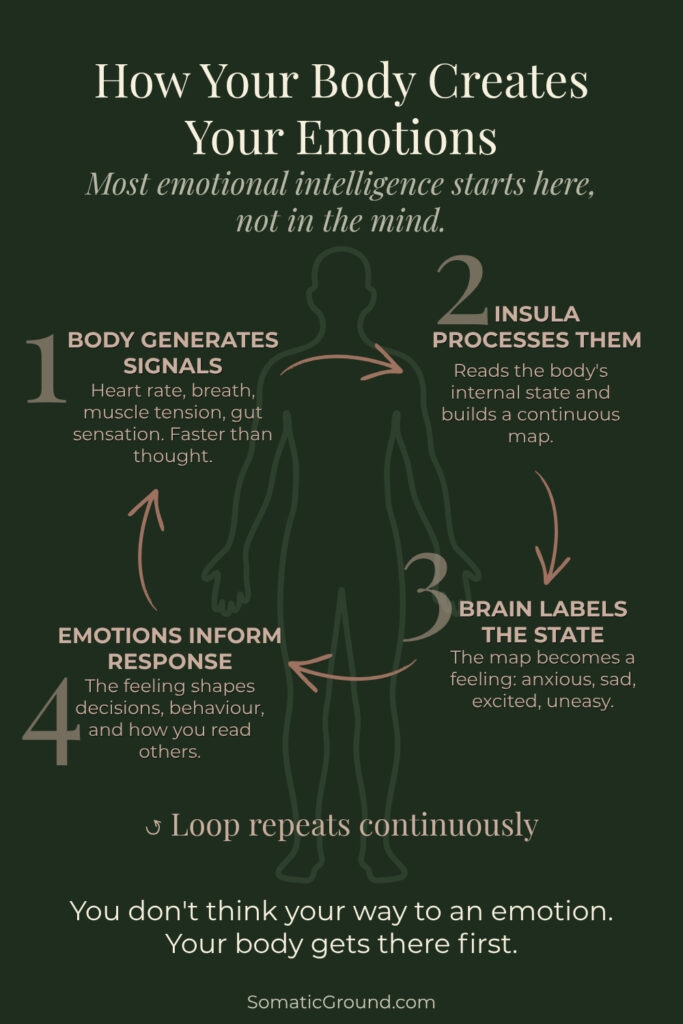
The neuroscience tells a different story. Emotions are not primarily mental events. They’re physiological ones. They begin in the body, as changes in heart rate, breath, muscle tension, gut sensation, and hormonal state, and are then read by the brain and labelled as feelings. The accuracy of that reading depends on something that most EQ frameworks don’t mention at all: interoception.
What interoception is
Interoception is the brain’s capacity to sense the internal state of the body. It covers everything from obvious sensations like hunger, thirst, and pain, to subtler ones like the slight tightening in the chest before an anxious thought has fully formed, the change in breath that precedes a strong emotion, the gut sense of something being wrong before the mind has processed why.
The insula, a region deep within the brain’s cortex, is the primary hub for interoceptive processing. It receives signals from the body’s organs and tissues and integrates them into a continuous map of the body’s internal state. This map is updated constantly, and it feeds into emotional experience, decision-making, social cognition, and the sense of being a self inhabiting a body.
The research on interoception has developed considerably over the past two decades, and the findings consistently point in the same direction: better interoceptive awareness is associated with better emotional regulation, greater empathy, more accurate decision-making, and a more stable sense of self.
Why emotions start in the body
The James-Lange theory of emotion, proposed independently by William James and Carl Lange in the 1880s, suggested that what we call emotions are the brain’s interpretation of physiological changes rather than the cause of them. You don’t run because you’re afraid, James argued that you’re afraid because you notice that you’re running.
This theory fell out of favour for a while but has been substantially rehabilitated by modern neuroscience. Antonio Damasio’s somatic marker hypothesis, developed through research on patients with damage to the prefrontal cortex and insula, proposes that the body generates somatic markers, physiological signals that tag options and outcomes with feeling tones, and that these markers are essential to reasoning and decision-making rather than incidental to it.
Damasio’s patients with insula damage could reason logically but made consistently poor decisions in their lives, apparently because they’d lost access to the physiological signals that normally guide judgment. The body wasn’t just a vehicle for the mind’s decisions. It was part of the decision-making apparatus.
Interoception and emotional regulation
The connection between interoception and emotional regulation is direct and well-documented.
Emotion regulation requires noticing that an emotion is arising before it has fully taken hold, which requires some capacity to detect the early physiological signals that precede emotional experience. Someone with good interoceptive awareness notices the slight increase in heart rate, the change in breathing quality, or the tension appearing in the jaw before they’re fully activated, and has more opportunity to respond rather than just react.
Someone with poor interoceptive awareness, by contrast, may not notice an emotional state until it’s fully developed and already driving behaviour. From the outside this can look like emotional volatility or impulsivity, but the underlying issue is often that the person simply doesn’t have good access to the early warning signals their body is sending.
Research also shows that people with higher interoceptive accuracy, measured by their ability to detect their own heartbeat, tend to experience emotions more intensely and process them more efficiently. The body’s signals aren’t noise to be filtered out — they carry information that the mind uses to understand what’s happening and what to do about it.
Interoception and empathy
The same mechanism that underlies self-awareness also underlies empathy, and this is one of the more interesting findings in interoception research.
When we observe someone else’s emotional state, the insula activates in ways that simulate that state in our own body. We feel something of what they feel not through cognitive inference alone but through a bodily resonance that is mediated by the insula and related structures. This is the mechanism behind what researchers call embodied simulation, and it suggests that empathy is not primarily a thinking process but a bodily one.
This has direct implications for relationships. A person who is disconnected from their own body, who has limited interoceptive awareness, will also tend to have less access to the embodied resonance that underlies genuine empathy. They may be able to reason about another person’s emotional state intellectually without actually feeling it, and the difference is usually detectable by the person on the receiving end.
What reduces interoceptive awareness
Several things impair the brain’s capacity to accurately read internal body states, and many of them are common.
Chronic stress and trauma are significant factors. When the nervous system is chronically activated, the insula’s processing becomes less accurate, partly because the system is overwhelmed with threat signals and partly because dissociation, which commonly develops in response to overwhelming experience, involves a deliberate dampening of body awareness as a protective mechanism. For many people with trauma histories, the body doesn’t feel like a safe place to pay attention to, and the interoceptive system adjusts accordingly.
Alexithymia, the difficulty identifying and describing one’s own emotions, appears to be closely related to reduced interoceptive accuracy. People with alexithymia aren’t necessarily emotionally flat, but they have limited access to the felt sense of their emotions and often describe them in physical terms, “my stomach hurts,” rather than emotional ones.
Habitual distraction and screen use may also contribute, though the research here is less established. The sustained external focus that characterises much of modern life doesn’t support the inward attention that interoception requires.
How to develop interoceptive awareness
The good news is that interoceptive awareness appears to be trainable, and several practices that improve it are already covered elsewhere on this site.
Body scan meditation is probably the most direct. Systematically turning attention through the body and noticing what’s there, without trying to change it, builds the neural pathways that support accurate interoceptive processing. The insula shows increased grey matter in experienced meditators, consistent with improved interoceptive capacity.
Somatic practices more broadly, including Somatic Experiencing, yoga, and mindful movement, develop body awareness as a central component rather than a side effect. The practice of noticing physical sensation in real time, tracking what happens in the body during different emotional states, is essentially interoceptive training.
Therapy that works with the body rather than just with narrative helps too, particularly for people whose interoceptive awareness has been dampened by trauma. Gradually learning to tolerate attention to internal sensation, with support, rebuilds the capacity that dissociation interrupted.
Even simple habits help: pausing before eating to notice genuine hunger rather than eating on schedule, checking in with physical sensation at regular points during the day, noticing what happens in the body at the beginning of a difficult conversation before attending to its content.
Read next
- What Is the Vagus Nerve and Why Does It Matter?
- Mindfulness and the Nervous System: What Actually Changes in the Brain
- 5 Somatic Grounding Exercises for Anxiety
SomaticGround.com explores the science of the nervous system and its connection to relationships, healing, and the embodied life. All content is for educational purposes and is not a substitute for professional medical or psychological care.