

Why Your Nervous System Shuts Down in Arguments
This post contains affiliate links. If you buy something through one of them, we may earn a small commission — at no extra cost to you. We only recommend things we'd genuinely stand behind.
Going quiet isn’t the same as not caring. This is what’s actually happening.

You’re in the middle of a hard conversation, things escalate, and then something happens – the words stop coming, you go quiet, you feel yourself leaving the room even though you’re still sitting in it. Later you might call it shutting down, zoning out, or going blank. Your partner might call it stonewalling, withdrawing, or not caring enough to engage.
Neither description is quite right.
What’s happening is a nervous system response. An old one, faster than thought, and not under your conscious control in the way most of us assume.
The biology of it
When the nervous system perceives threat (and conflict with someone we love absolutely registers as threat) it moves through a hierarchy of options. First it tries the social engagement system – stay connected, use your voice, work it out. If that feels insufficient or unsafe, it escalates to fight or flight. If fight or flight also feels impossible, if the threat feels inescapable, or if past experience has taught the system that mobilising makes things worse, it takes a third option.
Shutdown.
This is the dorsal vagal response, the oldest branch of the autonomic nervous system, shared with reptiles and other vertebrates. Heart rate drops, breathing becomes shallow, and the mind goes quiet or goes somewhere else entirely. In animals it’s the freeze or collapse response, a last resort when every other option has failed.
In a relationship argument it looks like going silent, one-word answers, staring at the wall, present in body, but nowhere else.
It’s not a choice, and it’s not indifference. It’s a body that has reached its limit.
Why some people shut down more than others
Not everyone defaults to shutdown in conflict. Some escalate, voice raised, and/or words coming fast. Both are nervous system responses. The difference usually comes down to what was learned early.
People who grew up in environments where expressing distress made things worse, where emotional activation was met with punishment or dismissal, or where conflict was genuinely dangerous, often develop shutdown as their default. The system learned: don’t mobilise, go small, and wait for it to pass.
This overlaps considerably with avoidant attachment, where the nervous system adapted to suppress emotional needs rather than express them. It also shows up frequently in people with trauma histories, particularly where fighting back or leaving wasn’t an option. Sometimes it’s simply a family template, a household where conflict was handled through silence and withdrawal, and the nervous system absorbed that as normal.
What’s happening for the other person
Shutdown doesn’t happen in isolation, and it’s worth understanding the dynamic it creates.
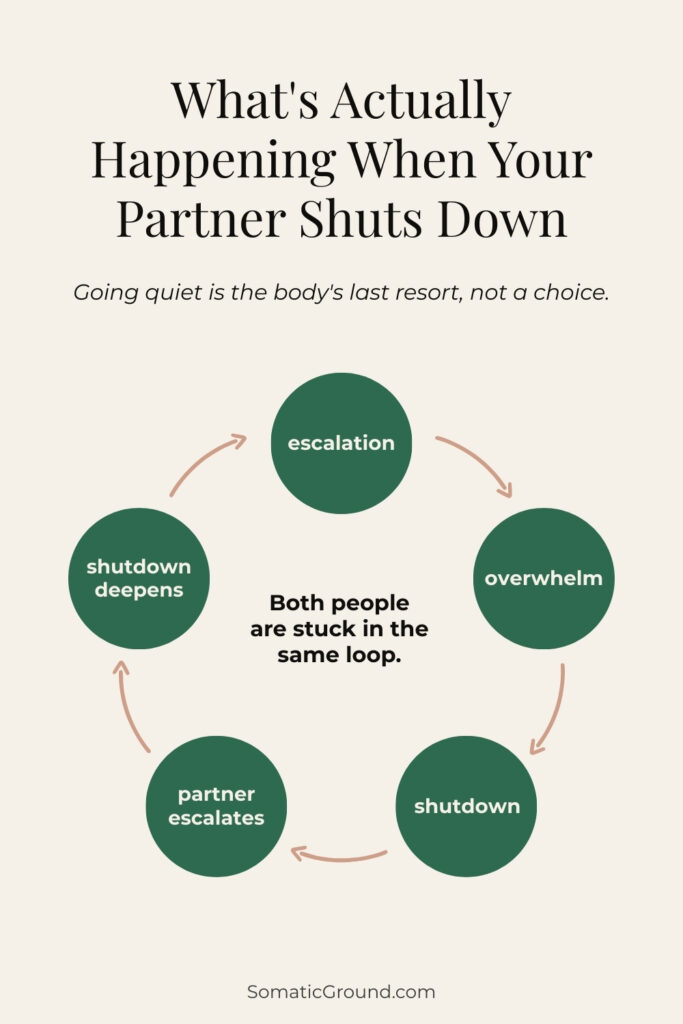
For someone with an anxious attachment pattern, a partner’s shutdown can feel like abandonment. The withdrawal triggers their own threat response, which produces more activation. More words, more urgency, and more pressure to get a response, which deepens the shutdown and increases the pressure. The cycle feeds itself, and both people end up further from the conversation they actually needed to have.
Neither person is doing this on purpose. Both are in nervous system states running their own threat programs. “You always shut down” and “you always push” are descriptions of two incompatible physiological responses, not character assessments. Understanding it that way changes what’s possible.
What to do when you feel it coming
The window for intervening is early. Once the dorsal vagal response is fully engaged, language and rational thought are genuinely harder to access, the prefrontal cortex has gone partly offline. The time to work with it is when you notice the early signs: attention narrowing, a heaviness in the chest, the pull toward leaving.
Naming it out loud, if you have enough presence to do so, helps. Something simple: “I’m starting to feel overwhelmed and I need a few minutes.” Using your voice is itself a regulating act. It also tells your partner what’s happening rather than leaving them to interpret silence, which they will, and usually not charitably.
A genuine break means leaving the room, going outside, doing something physical. Twenty minutes is roughly the minimum for stress hormones to clear enough that the prefrontal cortex can come back online. Coming back before that tends to just continue the fight with slightly different words.
The break needs to be for regulation, not for building your case. Walking helps. Slow breathing helps. Replaying the argument and rehearsing what you should have said keeps the sympathetic system active, and you’ll return more wound up than when you left.
For this to work, both people need to agree in advance on what a break means, ideally outside of conflict when both systems are calm enough to have the conversation. The agreement needs to be explicit: a break is a pause with a return, not an exit. Without that shared understanding, calling a break often makes things worse.
The longer work
Managing shutdown in the moment matters. The deeper question is what the shutdown is protecting.
For most people it developed for a reason. The nervous system learned that going quiet was safer than staying present. Updating that means giving the system enough new experience that it starts to revise its threat assessment, repeated exposure to conflict that gets survived, repaired, and resolved, in relationships where staying present turns out not to end the way it used to.
Emotionally Focused Therapy was developed specifically to address these kinds of relational cycles, and the research behind it is strong. Online-Therapy.com has therapists trained in EFT if you want to work with someone on this. Use code THERAPY20 for 20% off.
The Gottman Institute’s research on what they call flooding, their term for the physiological overwhelm that produces shutdown, is also worth looking into. Their free article on the topic explains it clearly and is a good companion to the work described here.
Read next
- Signs Your Nervous System Is Dysregulated
- What Is the Window of Tolerance?
- Co-Regulation: Why You Need a Calm Partner to Feel Safe
SomaticGround.com explores the science of the nervous system and its connection to relationships, healing, and the embodied life. All content is for educational purposes and is not a substitute for professional medical or psychological care.